


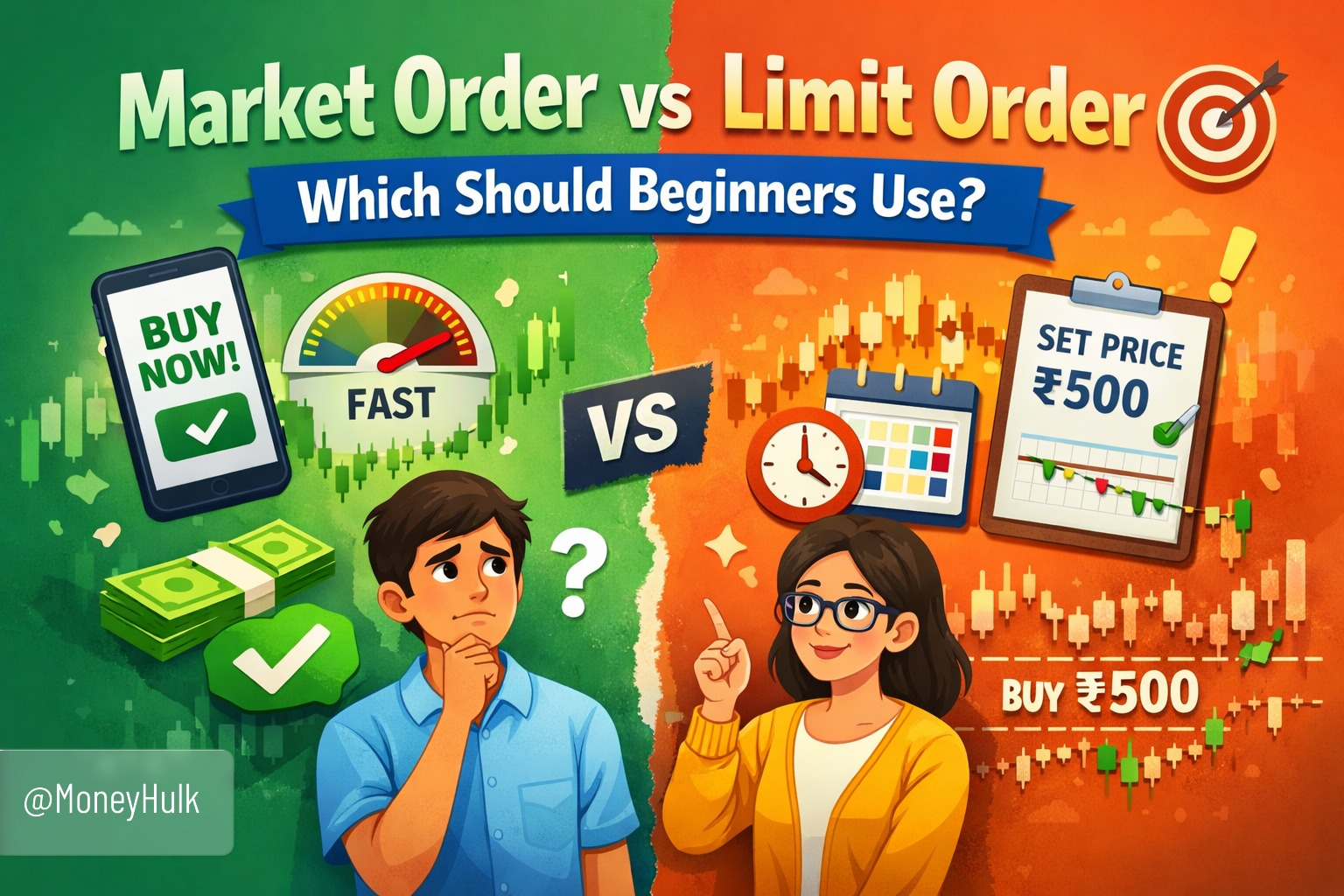
If you’ve ever tried to buy a stock and got confused between Market Order and Limit Order, you’re not alone.
This choice looks small, but it often decides how much you actually pay for a share.
Let’s clear this up in simple words.
Quick Answer (If You’re in a Hurry)
- Market Order → Buy or sell immediately at current price
- Limit Order → Buy or sell only at a price you choose
👉 For most beginners, Limit Order is safer.
👉 Market Order is simpler but less controlled.
Now let’s understand why.
What Is a Market Order?
A market order means:
“Buy or sell this share right now at whatever price is available.”
You are telling the system:
- Speed matters more than price
- I’m okay with small price changes
When a Market Order Works Fine
- Highly popular stocks
- Very liquid shares (lots of buyers and sellers)
- When price difference is usually small
Risk with Market Orders
- You don’t control the final price
- In fast markets, price may move suddenly
- You may pay slightly more than expected
For beginners, this price uncertainty can be uncomfortable.
What Is a Limit Order?
A limit order means:
“Buy or sell only at my chosen price.”
You decide:
- The maximum price you’ll pay (for buying)
- Or the minimum price you’ll accept (for selling)
If the market doesn’t reach your price, the order simply doesn’t execute.
Simple Example (₹ Based)
You want to buy a stock currently showing ₹500.
Using Market Order
- You place the order
- It executes immediately
- Final price could be ₹500, ₹502, or ₹505
You don’t know in advance.
Using Limit Order
- You set buy price at ₹495
- Order executes only if price comes to ₹495
- If not, order stays pending
You stay in control.
Market Order vs Limit Order (Side-by-Side)
| Feature | Market Order | Limit Order |
|---|---|---|
| Speed | Immediate | Depends on price |
| Price control | No | Yes |
| Risk | Slight price mismatch | No price surprise |
| Beginner friendly | Medium | High |
| Stress level | Higher in volatile markets | Lower |
Which One Should Beginners Use?
Use Limit Order if:
- You are new to investing
- You want price control
- You are buying for delivery (long-term)
- You don’t want surprises
Use Market Order if:
- Stock is very liquid
- You’re okay with small price changes
- Speed matters more than exact price
For most beginners, limit order builds discipline.
A Common Beginner Mistake
Many beginners think:
“Market order is better because it executes instantly.”
Instant execution is not always a benefit.
Paying a slightly higher price repeatedly adds up over time.
One Simple Rule to Remember
- Learning stage → Limit order
- Experienced stage → Depends on situation
There’s no reward for being fast in investing.
There is reward for being calm.
Final Takeaway
Market order and limit order are just tools.
Neither is good or bad by default.
But for beginners:
- Price control matters more than speed
- Limit orders reduce regret
- Discipline matters more than excitement
If you ever feel unsure, choose a limit order.

Sethuram Kishore is the founder of MoneyHulk and Worthview, with over 18 years of experience in SEO, digital marketing, and online publishing. Since launching Worthview in 2008, he has published hundreds of articles across finance, business, technology, and consumer topics. Through MoneyHulk, he shares practical, research-backed guides on personal finance, investing, banking, entrepreneurship, and wealth building.


