


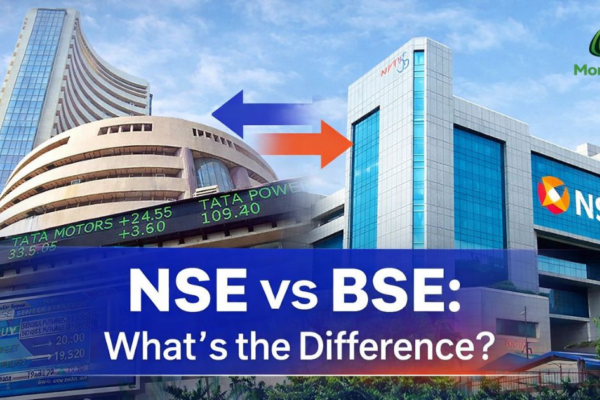
The difference between NSE and BSE comes down to speed, scale, and market focus. National Stock Exchange (NSE) dominates in trading volume and derivatives, while Bombay Stock Exchange (BSE) leads in legacy, number of listed companies, and index history.
If you’re an investor, trader, or just trying to understand India’s stock markets, knowing where trading happens—and why it matters—can directly affect costs, liquidity, and execution quality.
What Is a Stock Exchange? (In One Line)
A stock exchange is a marketplace where shares are bought and sold.
Just like:
- Vegetable market → vegetables
- Mobile store → phones
Stock exchange → company shares
Learn more about the terminology used in Stock market.
What Is NSE?
NSE stands for National Stock Exchange.
It is:
- One of India’s main stock exchanges
- Known for faster technology
- Widely used by modern trading apps
Most beginners unknowingly trade on NSE because many apps show NSE prices by default.
What Is BSE?
BSE stands for Bombay Stock Exchange.
It is:
- India’s oldest stock exchange
- Started in the 1800s
- Still actively used today
Many well-known companies were first listed on BSE.
Why Does India Have Two Major Stock Exchanges?
Short answer: Because they evolved to solve different market problems at different times.
India’s dual-exchange system exists due to history, regulation, and technology shifts—not duplication.
Core reasons:
- BSE (1875) emerged organically as Asia’s oldest exchange, rooted in physical trading.
- NSE (1992) was created after the Harshad Mehta scam to bring electronic, transparent trading nationwide.
- Regulators like SEBI encouraged competition to improve efficiency.
- Over time, markets specialized instead of converging completely.

Differences between BSE and NSE
| Feature | BSE (Bombay Stock Exchange) | NSE (National Stock Exchange) |
| Established | 1875 (Oldest in Asia) | 1992 (Modern, Electronic-first) |
| Benchmark Index | SENSEX (30 Stocks) | NIFTY 50 (50 Stocks) |
| Listed Companies | ~5,300+ | ~2,100+ |
| Global Ranking | World’s fastest exchange (6 microsecs) | World’s largest derivatives exchange |
| Global market capitalization rank | 7th | 8th |
| Primary Strength | Vast number of listed companies | Massive trading volumes/Liquidity |
| Website | https://www.bseindia.com | https://www.nseindia.com/ |
| Best For | Long-term, SMEs | Active traders, F&O |
| Liquidity (Average Daily Turnover) | Low | High |
| Derivatives (F&O) Market Share | Limited F&O participation | ~90%+ of India’s F&O volumes |
Do Share Prices Differ Between NSE and BSE?
Sometimes, slightly.
Why?
- Buyers and sellers are different on each exchange
- Demand and supply changes every second
But for normal investors:
- The difference is usually very small
- It does not impact long-term investing
Do You Need Two Different Accounts for NSE and BSE?
No.
One trading account and one demat account is enough.
Your broker automatically connects you to:
- NSE
- BSE
(or both)
You don’t have to worry about this at all.
How do SEBI regulations harmonize these exchanges?
Regardless of the exchange you choose, the regulatory framework remains identical. Both entities are governed by the Securities and Exchange Board of India (SEBI). This ensures that whether you trade on the BSE or NSE, your investor protections, settlement cycles (currently T+1), and tax obligations (like STT) remain uniform.
Bottom Line
The NSE vs BSE difference isn’t about which is better—it’s about what you need from the market. India benefits from having both: one built for modern trading efficiency, the other for depth and legacy reach.

Sethuram Kishore is the founder of MoneyHulk and Worthview, with over 18 years of experience in SEO, digital marketing, and online publishing. Since launching Worthview in 2008, he has published hundreds of articles across finance, business, technology, and consumer topics. Through MoneyHulk, he shares practical, research-backed guides on personal finance, investing, banking, entrepreneurship, and wealth building.


