


The Union Budget 2026–27 is not a “populist budget” for quick market sugar highs. Instead, it is a long-term, capex-driven, manufacturing-focused budget. For investors, the message is clear: themes matter more than individual stocks.
Let’s break down who wins and who loses from an investor’s lens.
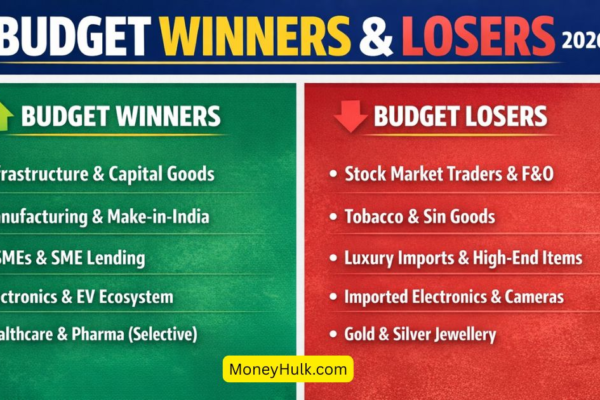
🟢 BUDGET WINNERS
🚧 1. Infrastructure & Capital Goods
Why they win:
Public capex has been raised to ₹12.2 lakh crore, with major allocations toward railways, freight corridors, waterways, and urban connectivity.
Key tailwinds
- High-speed rail corridors
- New freight corridor (Dankuni–Surat)
- National waterways & coastal shipping push
Investor takeaway:
Order books remain strong. Earnings visibility improves for 3–5 years.
Segments to watch
- EPC & construction
- Railways & metro projects
- Capital goods manufacturers
- Cement & engineering companies
🏭 2. Manufacturing & Make-in-India Plays
Why they win:
The government is doubling down on domestic production.
Budget support includes
- Biopharma SHAKTI (₹10,000 crore)
- ISM 2.0 (Semiconductors)
- Electronics manufacturing push to ₹40,000 crore
- Revival of 200 legacy industrial clusters
Investor takeaway:
This is a multi-year structural story, not a one-quarter trade.
Segments to watch
- Electronics manufacturing services (EMS)
- Semiconductors & ancillaries
- Specialty chemicals
- Pharma manufacturing
🧾 3. MSMEs & SME-Focused Businesses
Why they win:
Cash flow and compliance pain points are being directly addressed.
Big positives
- ₹10,000 crore SME Growth Fund
- Mandatory TReDS usage by CPSEs
- “Corporate Mitras” for compliance support
Investor takeaway:
Better working capital cycles = healthier balance sheets.
Segments to watch
- SME banks & NBFCs
- Fintechs linked to MSME lending
- Logistics & B2B platforms
📱 4. Electronics, Smartphones & EV Ecosystem
Why they win:
Lower import duties on components reduce costs and improve margins.
Key changes
- Reduced BCD on mobile components
- Duty exemptions extended for EV battery cells
- Lower customs on lithium-ion battery scrap
Investor takeaway:
Margin expansion + volume growth = valuation comfort.
Segments to watch
- Smartphone manufacturers
- EV OEMs & battery makers
- Auto ancillaries linked to EVs
🏥 5. Healthcare & Pharma (Selective)
Why they win:
Healthcare costs are being rationalised.
Support areas
- Full duty exemption on 10 cancer drugs
- Lower BCD on medical equipment like X-ray & cancer treatment machines
Investor takeaway:
Strong boost for domestic healthcare manufacturing.
Segments to watch
- Hospital chains
- Medical equipment manufacturers
- Pharma companies with oncology exposure
🔴 BUDGET LOSERS
📉 1. Stock Market Traders & F&O Platforms
Why they lose:
Higher Securities Transaction Tax (STT) increases trading costs.
STT hikes
- Futures: 0.05%
- Options: 0.15%
Investor takeaway:
- Negative for high-frequency traders
- Potential volume moderation in retail F&O activity
Segments under pressure
- Broking platforms
- Trading-heavy fintechs
🚬 2. Tobacco & Sin Goods
Why they lose:
Excise duty and NCCD increased on tobacco products.
Impact
- Margin pressure
- Volume risks in price-sensitive segments
Investor takeaway:
Defensive nature remains, but near-term sentiment weakens.
👜 3. Luxury Imports & Premium Consumption
Why they lose:
Higher duties on imported luxury goods.
Affected categories
- Premium watches
- High-end alcohol
- Imported cosmetics & perfumes
- Foreign-built cars (CBUs)
Investor takeaway:
Negative for companies dependent on import-led premium sales.
📸 4. Imported Electronics & Professional Equipment
Why they lose:
Higher duties on:
- High-end cameras
- Filming & sound equipment
- LED lamps and select electronics
Investor takeaway:
Pushes demand toward domestic manufacturing, but import-heavy players may struggle.
💰 5. Gold & Silver Jewellery (Short-Term)
Why they lose (slightly):
Adjusted duties on jewellery-related imports could raise prices.
Investor takeaway:
- Short-term demand softness possible
- Long-term gold thesis remains intact due to macro factors
🧠 MoneyHulk Investor Verdict
Union Budget 2026–27 clearly tells investors one thing:
“Trade less. Invest more. Think long term.”
This budget rewards:
- Infrastructure builders
- Manufacturing champions
- MSME enablers
- EV & electronics ecosystems
And it penalises:
- Speculative trading
- Import-heavy luxury consumption
Smart money will follow themes, not noise.
FAQs: Union Budget 2026–27 – Winners & Losers
1. Is Union Budget 2026–27 positive for the stock market?
Overall, yes—but selectively. The budget strongly supports infrastructure, manufacturing, MSMEs, electronics, EVs, and healthcare. However, it is negative for short-term traders due to higher STT on futures and options.
2. Which sectors are the biggest winners in Budget 2026–27?
The biggest winners include:
- Infrastructure & capital goods
- Manufacturing & Make-in-India sectors
- MSMEs and SME lending platforms
- Electronics and EV ecosystem
- Healthcare and select pharma companies
These sectors benefit from higher capex, duty cuts, and policy support.
3. Who are the biggest losers from Budget 2026–27?
The sectors facing pressure are:
- Stock market traders (especially F&O traders)
- Tobacco and sin goods companies
- Luxury import–dependent businesses
- Imported electronics and high-end camera equipment
- Gold and silver jewellery (short-term impact)
4. How does the STT hike impact retail investors?
The increase in Securities Transaction Tax (STT) raises trading costs for futures and options. This mainly affects frequent and high-volume traders, while long-term equity investors remain largely unaffected.
5. Is this budget good for long-term investors?
Yes. Budget 2026–27 clearly favours long-term investing over short-term speculation. Infrastructure creation, manufacturing incentives, and MSME support provide multi-year growth visibility.
6. Will gold prices rise because of this budget?
Gold and silver jewellery may see short-term price pressure due to changes in duties on related imports. However, the long-term outlook for gold continues to depend more on global factors like inflation, interest rates, and geopolitical risks.
7. Does Budget 2026–27 support electric vehicles (EVs)?
Yes. The budget extends duty exemptions on EV battery cells, lowers customs on lithium-ion battery scrap, and supports domestic manufacturing—positive for the EV supply chain and auto ancillaries.
8. How does this budget help MSMEs?
MSMEs benefit through:
- ₹10,000 crore SME Growth Fund
- Mandatory TReDS onboarding by CPSEs
- Compliance support via “Corporate Mitras”
These steps improve cash flow, credit access, and ease of doing business.
9. Should investors expect immediate market rallies after this budget?
Not necessarily. This is a structural, long-term budget, not a short-term sentiment booster. Markets may remain volatile initially, but theme-based stocks could outperform over time.
10. What is the key takeaway for investors from Budget 2026–27?
The key message is simple:
Invest in growth themes, not trading noise.
Sectors aligned with infrastructure, manufacturing, technology, and healthcare are best positioned to benefit from this budget over the next few years.

Sethuram Kishore is the founder of MoneyHulk and Worthview, with over 18 years of experience in SEO, digital marketing, and online publishing. Since launching Worthview in 2008, he has published hundreds of articles across finance, business, technology, and consumer topics. Through MoneyHulk, he shares practical, research-backed guides on personal finance, investing, banking, entrepreneurship, and wealth building.


