


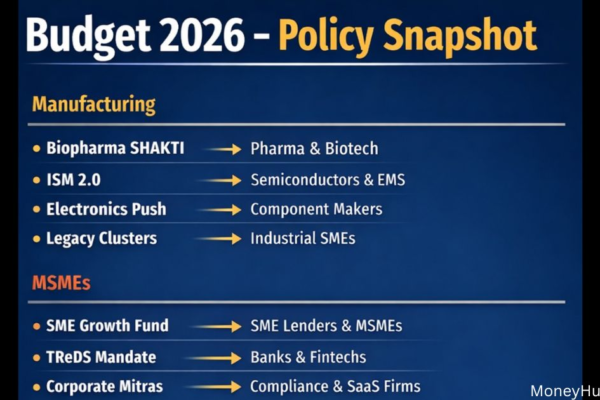
Union Budget 2026–27 announces a wide set of policy measures aimed at accelerating economic growth, strengthening domestic manufacturing, supporting MSMEs, and maintaining fiscal discipline. The budget outlines sector-specific schemes, funding commitments, and regulatory changes that collectively define the government’s economic priorities for the coming years.
Presented on February 1, 2026, by Nirmala Sitharaman, Union Budget 2026–27 focuses on capex-led growth, manufacturing revival, MSME support, infrastructure expansion, and simplified compliance, while targeting a fiscal deficit of 4.3% of GDP.
The major policy announcements in Budget 2026–27 fall into seven core areas:
- Manufacturing and industrial development
- MSME and small business support
- Infrastructure and logistics expansion
- Taxation and compliance reforms
- Agriculture and rural development
- Social sector and inclusion
- Energy, EVs, and sustainability
What This Page Covers
- A complete list of major policy announcements made in Union Budget 2026–27
- Policies across manufacturing, MSMEs, infrastructure, taxation, agriculture, social sector, and sustainability
- Scheme-level highlights with key allocations and objectives
| Policy Area | Scheme / Announcement | Key Allocation / Detail | Primary Objective |
|---|---|---|---|
| Manufacturing | Biopharma SHAKTI | ₹10,000 crore | Boost domestic biopharma manufacturing |
| Manufacturing | India Semiconductor Mission (ISM) 2.0 | Expanded incentives | Build chip fabrication & design ecosystem |
| Manufacturing | Electronics Manufacturing Push | ₹40,000 crore | Strengthen electronics production & exports |
| Manufacturing | Legacy Industrial Clusters | 200 clusters | Modernise traditional manufacturing hubs |
| MSMEs | SME Growth Fund | ₹10,000 crore | Provide growth capital to scaling MSMEs |
| MSMEs | TReDS Mandate for CPSEs | Mandatory onboarding | Ensure faster payments to MSMEs |
| MSMEs | Corporate Mitras | New initiative | Simplify compliance in Tier-II/III towns |
| Infrastructure | Public Capital Expenditure | ₹12.2 lakh crore (FY27) | Drive growth via infrastructure investment |
| Infrastructure | High-Speed Rail Corridors | 7 corridors | Improve inter-city connectivity |
| Infrastructure | Freight Corridor | Dankuni–Surat | Enhance long-distance cargo movement |
| Logistics | National Waterways | 20 waterways | Lower logistics costs via inland transport |
| Energy | CCUS Projects | ₹20,000 crore | Reduce industrial carbon emissions |
| Taxation | New Income Tax Act, 2025 | Effective April 2026 | Simplify tax laws and compliance |
| Taxation | STT on Derivatives | Futures: 0.05%, Options: 0.15% | Discourage excessive speculative trading |
| Agriculture | Bharat-VISTAAR AI | New platform | Provide AI-based farm advisory |
| Agriculture | Reservoir Development | 500 reservoirs | Improve irrigation & water security |
| Social Sector | SHE-Marts | Expanded rollout | Support women entrepreneurs |
| Social Sector | NIMHANS-2 | New expansion | Strengthen mental health infrastructure |
| Regional Development | Purvodaya Initiative | Eastern India focus | Promote industrial growth in eastern states |
| Energy & EVs | EV Battery Duty Relief | Extended exemptions | Support EV manufacturing & adoption |
1️⃣ Manufacturing & Industrial Policy Announcements
Budget 2026–27 places manufacturing at the centre of India’s growth strategy by committing large, targeted funding to biopharma, semiconductors, electronics, and legacy industrial clusters. The objective is to deepen domestic value chains, reduce import dependence, and create long-term employment through scale-driven manufacturing.
TL;DR:
The government announced four major manufacturing policy moves—Biopharma SHAKTI (₹10,000 crore), ISM 2.0 for semiconductors, an electronics push raised to ₹40,000 crore, and the revival of 200 legacy industrial clusters—to accelerate India’s transition into a global manufacturing hub.
Key Manufacturing Policies Announced in Budget 2026–27
- Biopharma SHAKTI Scheme (₹10,000 crore)
- A new dedicated outlay to strengthen biopharmaceutical manufacturing, including vaccines, APIs, biologics, and advanced therapeutics.
- Focus areas include domestic capacity creation, R&D support, and reducing import reliance for critical drugs.
- India Semiconductor Mission (ISM) 2.0
- The next phase of India’s semiconductor programme aimed at chip fabrication, packaging, testing, and design ecosystems.
- Builds on earlier semiconductor incentives to attract global fabs and ancillary suppliers into India.
- Electronics Manufacturing Push Increased to ₹40,000 crore
- Enhanced budgetary support for electronics manufacturing, covering mobile devices, components, and supply-chain infrastructure.
- Intended to strengthen India’s position as a global electronics manufacturing and export base.
- Revival of 200 Legacy Industrial Clusters
- Government support for modernisation and productivity upgrades in older industrial clusters across multiple states.
- Focus on infrastructure upgradation, technology adoption, and employment generation in traditional manufacturing zones.
Why this matters:
Together, these measures signal a long-term manufacturing policy continuity, where capital allocation, technology depth, and cluster-based development are prioritised over short-term incentives.
2️⃣ MSME & Small Business Policy Announcements
Budget 2026–27 strengthens the MSME ecosystem by improving access to credit, ensuring faster payments, and reducing compliance burdens for small businesses. The focus is on making MSMEs financially stable, digitally integrated, and easier to run—especially in Tier-II and Tier-III towns.
The government announced multiple policy measures aimed at solving three long-standing MSME problems: funding gaps, delayed payments, and complex compliance.
Key MSME and Small Business Policies Announced in Budget 2026–27
- ₹10,000 crore SME Growth Fund
- A dedicated fund to support scaling MSMEs with growth capital.
- Designed to help small businesses expand capacity, adopt technology, and improve competitiveness.
- Targets enterprises that have outgrown micro financing but are not yet large corporates.
- Mandatory TReDS Onboarding for CPSEs
- All Central Public Sector Enterprises (CPSEs) are required to register on the Trade Receivables Discounting System (TReDS) platform.
- This ensures faster invoice payments to MSMEs by enabling bill discounting through banks and NBFCs.
- Aims to reduce working-capital stress caused by delayed government and PSU payments.
- “Corporate Mitras” for Compliance Support
- Introduction of Corporate Mitras to assist MSMEs with regulatory and compliance requirements.
- Support will be focused on Tier-II and Tier-III cities, where access to professional services is limited.
- Covers areas such as filings, documentation, and basic legal and financial compliance.
These measures position MSMEs as a core growth engine in Budget 2026–27, with policy support extending beyond credit to include payment security and operational ease.
3️⃣ Infrastructure & Logistics Policy Announcements
Budget 2026–27 reinforces infrastructure as the backbone of economic growth by sharply increasing public investment in transport, logistics, and energy transition projects. The focus is on improving connectivity, reducing logistics costs, and creating long-term employment through large-scale capital expenditure.
The government outlined multiple infrastructure initiatives covering railways, freight movement, waterways, coastal shipping, and clean energy infrastructure, supported by record public capex.
Key Infrastructure and Logistics Policies Announced in Budget 2026–27
- Public Capital Expenditure Raised to ₹12.2 Lakh Crore
- Capital spending for FY27 has been increased to ₹12.2 lakh crore, continuing the multi-year capex-led growth strategy.
- Funds will be directed toward transport infrastructure, urban development, and core economic assets.
- Seven High-Speed Rail Corridors
- New high-speed rail routes announced, including Mumbai–Pune, Delhi–Varanasi, and Hyderabad–Bengaluru.
- These corridors are intended to act as growth connectors between major economic and population centres.
- Dankuni–Surat Freight Corridor
- A new dedicated freight corridor linking Dankuni in West Bengal to Surat in Gujarat.
- Aims to decongest existing rail networks and improve long-distance cargo movement across eastern and western India.
- Development of 20 National Waterways
- Expansion of inland water transport through the development of 20 national waterways.
- Designed to provide a cost-efficient and sustainable alternative to road and rail logistics.
- Coastal Cargo Shipping Scheme
- Introduction of a coastal cargo policy to increase the share of inland and coastal shipping to 12% by 2047.
- Focuses on lowering logistics costs for bulk goods and industrial cargo.
- ₹20,000 Crore Allocation for CCUS Projects
- Allocation of ₹20,000 crore for Carbon Capture, Utilisation and Storage (CCUS) in energy and industrial sectors.
- Intended to support India’s transition toward cleaner industrial and power-generation processes.
These infrastructure and logistics announcements signal continued policy emphasis on long-term asset creation, with government spending acting as a catalyst for private investment and regional development.
4️⃣ Taxation & Compliance Policy Announcements
Budget 2026–27 introduces targeted tax reforms aimed at simplifying compliance for taxpayers while increasing transaction costs in selected speculative and luxury segments. The approach combines structural simplification with selective tightening, rather than broad-based tax changes.
The government focused on modernising tax laws, easing genuine expenses, and discouraging high-frequency speculative activity, while keeping the overall tax framework stable.
Key Taxation and Compliance Policies Announced in Budget 2026–27
- New Income Tax Act, 2025 (Effective April 2026)
- The existing Income Tax Act, 1961 will be replaced by a new, simplified Income Tax Act, 2025 from April 2026.
- The new law aims to reduce complexity by using clear language, fewer sections, and simpler compliance structures.
- The objective is to improve ease of understanding and reduce litigation over interpretations.
- Reduction in TCS on Overseas Expenses
- Tax Collected at Source (TCS) reduced to 2% on overseas tours, education, and medical expenses under the Liberalised Remittance Scheme (LRS).
- This provides relief to individuals making legitimate foreign remittances for education, healthcare, and travel.
- Increase in Securities Transaction Tax (STT)
- STT increased to 0.05% on futures and 0.15% on options transactions.
- The change increases trading costs for frequent derivatives traders, particularly in the retail F&O segment.
- Safe Harbour Rate for IT and IT-Enabled Services
- The safe harbour rate for IT and IT-enabled services has been set at 15.5%.
- Applicable for companies with turnover up to ₹2,000 crore, providing tax certainty and reducing transfer pricing disputes.
- Customs Duty Rationalisation
- Select customs duties have been revised to support domestic manufacturing while discouraging non-essential imports.
- Adjustments impact areas such as luxury goods, electronics components, medical equipment, and jewellery-related items.
These taxation and compliance measures indicate a policy direction focused on clarity, predictability, and compliance efficiency, while using tax tools to guide market behaviour.
5️⃣ Agriculture & Rural Development Policy Announcements
Budget 2026–27 focuses on improving farm productivity, water security, and income diversification through technology-driven and crop-specific interventions. The emphasis is on combining digital tools with infrastructure development to support farmers and rural economies.
The government announced policies covering AI-based farm advisory, crop diversification, irrigation expansion, and value-added agriculture, aimed at making farming more resilient and profitable.
Key Agriculture and Rural Development Policies Announced in Budget 2026–27
- Bharat-VISTAAR AI for Farm Advisory
- Launch of Bharat-VISTAAR AI, an artificial intelligence–based platform for real-time farm advisory services.
- Designed to provide farmers with guidance on crop planning, weather, pest control, and best practices using data-driven insights.
- Support for High-Value and Plantation Crops
- Targeted support announced for cashew, cocoa, coconut, and other high-value horticulture crops.
- Aims to promote crop diversification, higher farmer incomes, and export-oriented agriculture.
- Development of 500 New Reservoirs
- The government will support the development of 500 reservoirs across multiple states.
- The objective is to improve irrigation coverage, water storage, and drought resilience in rural areas.
- Boost to Horticulture and Allied Activities
- Policy measures to strengthen horticulture, floriculture, and allied agricultural activities.
- Focus on improving post-harvest infrastructure, storage, and processing capacity.
These announcements reflect a shift toward technology-enabled, resource-efficient agriculture, with an emphasis on long-term sustainability and rural income growth.
6️⃣ Social Sector & Inclusion Policy Announcements
Budget 2026–27 strengthens social infrastructure by expanding support for women entrepreneurs, persons with disabilities, mental health services, and regional development. The policies focus on improving access to opportunities, essential services, and balanced regional growth.
The government introduced initiatives across women-led enterprises, social welfare, healthcare infrastructure, and eastern India’s industrial development.
Key Social Sector and Inclusion Policies Announced in Budget 2026–27
- SHE-Marts for Women Entrepreneurs
- Expansion of SHE-Marts to provide market access and visibility for women-led micro and small enterprises.
- Designed to support product marketing, branding, and sales channels for women entrepreneurs.
- Enhanced Support for Divyangjan
- New and expanded schemes for persons with disabilities (Divyangjan).
- Focus on improving access to education, skill development, employment, and assistive infrastructure.
- NIMHANS-2 for Mental Health Services
- Announcement of NIMHANS-2, a major expansion of mental health infrastructure.
- Builds on the work of NIMHANS to improve availability of specialised mental health care, training, and research capacity across regions.
- Purvodaya Initiative for Eastern India
- Launch of the Purvodaya initiative to accelerate industrial and economic development in eastern India.
- Focus regions include Bihar, Jharkhand, Odisha, West Bengal, and eastern Uttar Pradesh.
- Aims to promote industrial corridors, job creation, and regional balance.
These measures highlight the government’s intent to pair economic growth with social inclusion and regional equity, ensuring broader participation in India’s development trajectory.
7️⃣ Energy, EV & Sustainability Policy Announcements
Budget 2026–27 advances India’s clean energy and sustainability agenda by supporting electric mobility, battery manufacturing, and low-carbon industrial technologies. The policies focus on reducing import dependence, lowering transition costs, and enabling cleaner growth across energy-intensive sectors.
The government announced targeted measures covering electric vehicles (EVs), battery supply chains, and carbon-reduction technologies, with an emphasis on long-term sustainability.
Key Energy, EV and Sustainability Policies Announced in Budget 2026–27
- Support for Electric Vehicle (EV) Manufacturing
- Continued policy support for electric vehicle production and adoption across passenger and commercial segments.
- Measures are aligned with India’s broader EV roadmap to reduce fossil fuel dependence and transport emissions.
- Customs Duty Relief on EV Battery Inputs
- Extension of duty exemptions on EV battery cells and related components.
- Lower customs duty on lithium-ion battery scrap, supporting domestic recycling and cost efficiency.
- Intended to strengthen the local EV battery supply chain and improve price competitiveness.
- ₹20,000 Crore Allocation for CCUS Projects
- Allocation of ₹20,000 crore for Carbon Capture, Utilisation and Storage (CCUS) projects.
- Targeted at energy, cement, steel, and other high-emission industrial sectors.
- Aims to support India’s transition toward lower-carbon industrial processes while maintaining output.
- Clean Energy and Industrial Sustainability Focus
- Policy signals supporting cleaner fuels, energy efficiency, and emissions-reduction technologies.
- Designed to balance industrial growth with environmental commitments over the medium to long term.
These announcements reinforce Budget 2026–27’s approach of integrating energy transition and sustainability into core economic and industrial policy, rather than treating them as standalone initiatives.
Conclusion
Budget 2026–27 presents a policy-driven roadmap focused on long-term capacity building rather than short-term stimulus. Through targeted investments in manufacturing, MSMEs, infrastructure, agriculture, social inclusion, and clean energy, the government has outlined clear priorities for economic growth and structural reform.
Across sectors, the budget emphasises capital expenditure, domestic value-chain development, simplified compliance, and sustainability, while maintaining fiscal discipline with a deficit target of 4.3% of GDP. The policy announcements listed in this page collectively define the government’s economic direction for the coming years, with detailed implementation and sector-specific impact to be covered through individual scheme-focused pages.

Sethuram Kishore is the founder of MoneyHulk and Worthview, with over 18 years of experience in SEO, digital marketing, and online publishing. Since launching Worthview in 2008, he has published hundreds of articles across finance, business, technology, and consumer topics. Through MoneyHulk, he shares practical, research-backed guides on personal finance, investing, banking, entrepreneurship, and wealth building.


