


You have a business idea. Maybe you have been freelancing on the side and want to make it official. Maybe you are a salaried professional launching a service on weekends. Or maybe you are a first-time entrepreneur who has finally decided to stop waiting and start building.
The first question almost everyone asks at this stage is not about the product, the pricing, or the marketing. It is: “How do I register this thing?”
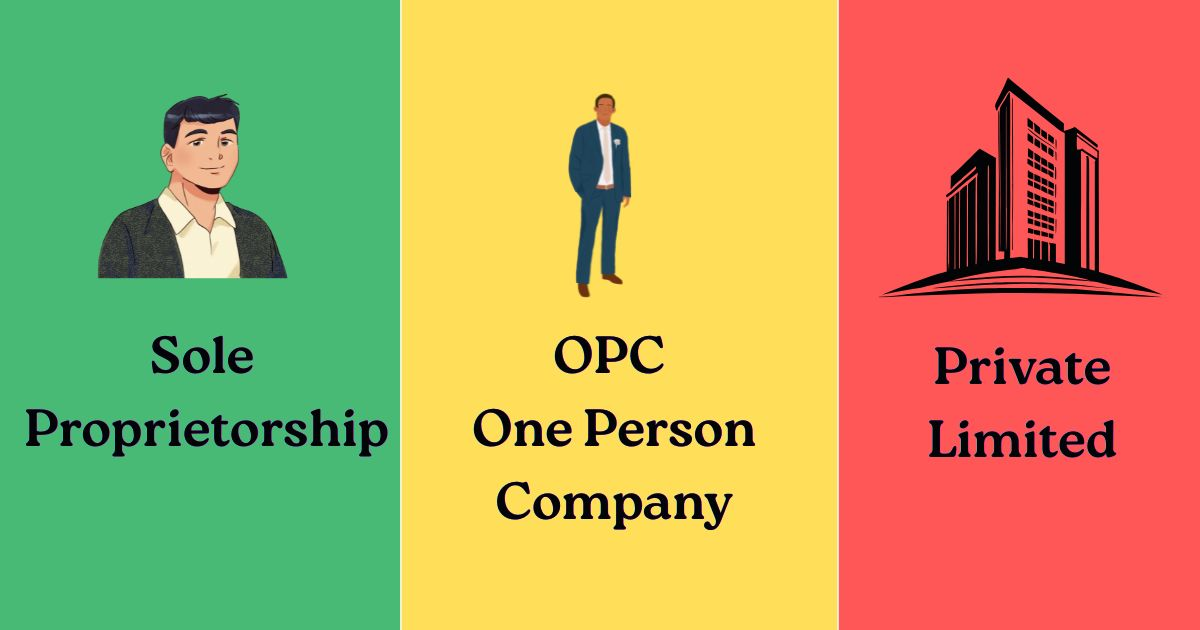
And that question leads to three options that confuse most people:
- Sole Proprietorship
- One Person Company (OPC)
- Private Limited Company (Pvt Ltd)
Each one is designed for a different kind of entrepreneur, a different level of ambition, and a different risk appetite. Choosing the wrong one at the start does not just cost money — it can complicate your taxes, limit your growth, and create personal financial risk you did not sign up for.
This guide breaks down all three structures in plain language, with real numbers, real examples, and a decision framework to help you choose the right one for your situation.
First, Meet Three People Just Like You
Before we get into the technicalities, let us introduce three people whose stories will guide us through this comparison.
Priya is a 27-year-old freelance graphic designer in Pune. She earns around ₹4–5 lakh a year from clients, mostly small businesses. She wants to open a bank account in her business name and issue proper invoices. She does not plan to hire anyone soon.
Rahul is a 34-year-old software engineer in Bengaluru who earns ₹18 lakh per year from his job. On the side, he has been building a SaaS tool for small retailers and wants to sell it officially, protect his personal assets, and eventually raise some money.
Sneha is a 30-year-old content creator and online coach in Delhi. She runs paid workshops and sells digital courses. She wants to build a proper brand, eventually bring in a partner, and is thinking long-term.
Their stories will help make this comparison real.

The Big Picture: What Are These Three Structures?
Sole Proprietorship — The Simplest Start
A sole proprietorship is not really a “registered company” in the legal sense. It is just you — doing business under your name or a trade name. The law sees you and your business as the same person.
There is no formal registration required to start. You might get a GST number, an MSME (Udyam) registration, or a Shop & Establishment licence depending on your state and business type — but there is no Ministry of Corporate Affairs (MCA) involvement.
Think of it like this: if Priya starts sending invoices as “Priya Designs” without registering anything formal, she is technically a sole proprietor.
Who it is for: Small businesses, local shops, freelancers, consultants, and anyone who wants to test an idea before committing to a formal structure.
One Person Company (OPC) — The Smart Middle Ground
An OPC was introduced under the Companies Act, 2013, specifically for solo entrepreneurs. It gives a single person all the benefits of running a proper company — limited liability, a separate legal identity, and a professional structure — without needing a co-founder or partner.
You are both the sole shareholder and the sole director. You must also appoint a nominee (a trusted person — typically a family member) who would take over the company if something happened to you.
OPC is registered with the MCA and follows company law, though with fewer compliance requirements than a Private Limited Company.
Who it is for: Solo entrepreneurs who want legal protection and credibility but are not ready (or willing) to bring in partners or investors.
Private Limited Company — The Growth-Ready Structure
A Private Limited Company is the most robust of the three. It requires at least two directors and two shareholders, though one person can hold both roles alongside a trusted family member or co-founder.
It is a fully separate legal entity — it can own assets, sign contracts, sue and be sued in its own name, and take on investors. Banks, large clients, and VCs treat a Pvt Ltd with far more seriousness than a proprietorship or even an OPC.
However, it comes with the most compliance requirements and the highest ongoing costs.
Who it is for: Entrepreneurs who plan to scale, raise funding, build a team, or want maximum legal protection and institutional credibility from day one.
The Detailed Comparison
1. Legal Identity & Liability — The Most Important Factor
This is where the three structures differ most dramatically, and where the stakes are highest.
| Factor | Sole Proprietorship | OPC | Private Limited |
|---|---|---|---|
| Separate legal entity? | ❌ No | ✅ Yes | ✅ Yes |
| Personal liability | Unlimited | Limited | Limited |
| Personal assets at risk? | ✅ Yes | ❌ No | ❌ No |
| Can own assets in company name? | ❌ No | ✅ Yes | ✅ Yes |
| Nominee required? | ❌ No | ✅ Yes | No (but 2 directors needed) |
What “unlimited liability” actually means:
If Priya (sole proprietor) takes a ₹5 lakh business loan to buy equipment and her business fails, the lender can go after her personal savings, her fixed deposits, even her parents’ home if she gave it as collateral. There is no wall between her personal life and her business life.
If Rahul registers an OPC and the same thing happens, the lender can only go after company assets. His salary account, his investments, his personal property — protected. (Unless, of course, he gave a personal guarantee for the loan, which is common for bank loans to small companies.)
This single difference — limited vs unlimited liability — is often reason enough to move beyond a proprietorship for anyone taking on financial risk.
2. Registration Process — How Hard Is It to Start?
| Factor | Sole Proprietorship | OPC | Private Limited |
|---|---|---|---|
| Governed by | No single law | Companies Act, 2013 | Companies Act, 2013 |
| Registration required | Not mandatory | Mandatory (MCA) | Mandatory (MCA) |
| Key documents | GST, Udyam, Shop Act | PAN, Aadhaar, DSC, DIN, INC forms | PAN, Aadhaar, DSC, DIN, MOA, AOA |
| Time to register | A few days | 7–15 working days | 10–20 working days |
| Minimum directors needed | 1 (you) | 1 (you) + 1 nominee | 2 |
| Minimum shareholders | N/A | 1 | 2 |
What DSC and DIN mean: A Digital Signature Certificate (DSC) is a USB device that acts as your digital signature for government filings. A Director Identification Number (DIN) is a unique ID for every company director in India. Both are required for OPC and Pvt Ltd, not for proprietorships.
For Priya, getting started as a sole proprietor means getting a GST number (free to apply online) and possibly an MSME registration (also free). She could be “registered” and invoicing clients within 2–3 days.
For Rahul going the OPC route, the process involves filing the SPICe+ form on the MCA portal, getting a DSC, getting a DIN, and waiting for the Certificate of Incorporation. He can do this himself, but most people hire a CA or online service to handle it.
3. Cost — What Will You Actually Spend?
This is where people often get surprised. There are two types of costs: registration costs (one-time) and compliance costs (recurring every year).
Registration Cost (Approximate)
| Structure | Government Fees | Professional Fees (CA/CS) | Total (Approx.) |
|---|---|---|---|
| Sole Proprietorship | ₹0 – ₹500 | ₹500 – ₹3,000 (optional) | ₹0 – ₹3,500 |
| OPC | ₹4,000 – ₹7,000 | ₹5,000 – ₹10,000 | ₹10,000 – ₹20,000 |
| Private Limited | ₹5,000 – ₹10,000 | ₹8,000 – ₹20,000 | ₹15,000 – ₹35,000 |
Government fees vary based on authorized capital and state of registration. Professional fees depend on the service provider.
Annual Compliance Cost (Approximate)
| Structure | Annual Compliance | Tax Filing |
|---|---|---|
| Sole Proprietorship | Minimal (ITR-3/4 only if turnover exceeds threshold) | Personal income tax slab rate |
| OPC | ₹8,000 – ₹20,000/year (ROC filings + mandatory audit) | Corporate tax at ~22% (plus surcharge & cess) |
| Private Limited | ₹15,000 – ₹40,000/year (ROC filings + audit + CA fees) | Corporate tax at ~22% (plus surcharge & cess) |
The hidden cost no one warns you about: Even if your OPC or Pvt Ltd makes zero revenue in a year, you still have to file annual returns with the MCA, appoint an auditor, and pay compliance costs. Skipping this leads to penalties of ₹100 per day per form — which adds up very quickly.
This is a key reason many early-stage founders start as sole proprietors and switch to a formal structure once revenue is consistent.
4. Taxation — Who Pays Less?
This is more nuanced than people think, and it depends entirely on your income level.
| Sole Proprietorship | OPC / Private Limited | |
|---|---|---|
| Taxed as | Individual (your personal income) | Company (flat corporate rate) |
| Tax rate | Slab-based: 5% to 30% (new tax regime) | ~22% + surcharge + cess (effective ~25.17%) |
| Can claim business deductions? | ✅ Yes | ✅ Yes |
| Dividend tax (taking money out) | N/A | Taxed in hands of shareholder |
| Tax audit threshold | ₹1 crore turnover (non-digital) | Mandatory every year |
The key insight: If your annual profit is below ₹10–12 lakh, you will likely pay less tax as a sole proprietor (because you fall in lower income tax slabs). Once your business profits grow significantly, the corporate rate of ~22% can become more tax-efficient than the 30% slab rate for individuals.
However, OPC and Pvt Ltd owners must also pay dividend tax when they take money out of the company for personal use — which reduces the tax advantage somewhat. Consult a CA before making this decision.
5. Credibility & Banking — Does Structure Matter for Clients?
| Factor | Sole Proprietorship | OPC | Private Limited |
|---|---|---|---|
| Bank account in business name | Limited options | ✅ Yes, current account | ✅ Yes, current account |
| Client trust (B2B contracts) | Low–Medium | Medium–High | High |
| Can raise equity funding? | ❌ No | ❌ No | ✅ Yes |
| Investor-friendly? | ❌ No | ❌ No | ✅ Yes |
| DPIIT Startup recognition | ❌ No | ✅ Yes | ✅ Yes |
| Can issue equity to employees (ESOPs)? | ❌ No | ❌ No | ✅ Yes |
This factor matters a lot more than most first-timers expect. Large companies, government contracts, and many export clients require you to have a formal corporate entity. If you are pitching to enterprise clients or applying for government tenders, a sole proprietorship will often disqualify you immediately.
For Sneha, who wants to build a brand and possibly partner with someone, a Pvt Ltd from the start gives her the cleanest foundation to scale.
6. Growth, Conversion & Scalability
| Factor | Sole Proprietorship | OPC | Private Limited |
|---|---|---|---|
| Can add partners/co-founders? | ❌ No (would become a partnership) | ❌ No | ✅ Yes |
| Can raise investor funding? | ❌ No | ❌ No | ✅ Yes |
| Can convert to Pvt Ltd? | Complex process | ✅ Yes (mandatory if turnover > ₹2 Cr or capital > ₹50 lakh) | N/A |
| Perpetual succession? | ❌ No (ends with owner) | ✅ Yes | ✅ Yes |
One important rule: OPC must mandatorily convert to a Private Limited Company once its paid-up capital exceeds ₹50 lakh or annual turnover crosses ₹2 crore. This is not optional. The government built this in so that growing businesses automatically graduate to a more robust structure.
For a proprietorship, converting to a Pvt Ltd is possible but involves more paperwork — you essentially need to transfer all assets and liabilities to the new entity, which can have tax implications.
The Full Summary Table
| Sole Proprietorship | OPC | Private Limited | |
|---|---|---|---|
| Best for | Freelancers, small local businesses | Solo entrepreneurs wanting protection | Startups, scaling businesses |
| Registration | None / Simple | MCA (7–15 days) | MCA (10–20 days) |
| Setup cost | ₹0 – ₹3,500 | ₹10,000 – ₹20,000 | ₹15,000 – ₹35,000 |
| Annual compliance | Minimal | ₹8,000 – ₹20,000 | ₹15,000 – ₹40,000 |
| Liability | Unlimited | Limited | Limited |
| Taxed as | Individual | Company | Company |
| Can raise funding | ❌ No | ❌ No | ✅ Yes |
| Credibility | Low–Medium | Medium–High | High |
| Scalability | Low | Medium | High |
| Minimum people needed | 1 | 1 + 1 nominee | 2 |
So, Which One Is Right for You?
Here is a simple decision framework. Answer these questions honestly:
1. Are you testing an idea or just starting out with low revenue (under ₹5–6 lakh/year)?
→ Start with a Sole Proprietorship. Keep costs low, validate your idea, and upgrade later.
2. Are you running a solo business with growing revenue and you want to protect your personal assets?
→ Go for an OPC. You get the legal protection of a company without needing a partner.
3. Are you planning to bring in a co-founder, raise investor money, or go after enterprise clients?
→ Register a Private Limited Company from day one. Restructuring later is expensive and complicated.
4. Are you a freelancer doing less than ₹20 lakh/year with low financial risk?
→ A Sole Proprietorship with GST registration is perfectly fine.
5. Is your business in a field with significant liability risk (consulting, tech services, coaching)?
→ At least go for an OPC. The protection is worth the extra ₹10,000–₹15,000 in setup cost.
Back to Priya, Rahul, and Sneha
Priya (freelance designer, ₹4–5 lakh/year, low financial risk) — A Sole Proprietorship makes complete sense for now. She should get a GST number, open a current account under her trade name, and focus on growing her client base. When her income crosses ₹10 lakh and she wants more formal credibility, she can register an OPC.
Rahul (SaaS product, wants liability protection, may raise money later) — He should register a Private Limited Company from the start. His product has real financial risk, his revenue could grow fast, and investors expect a Pvt Ltd structure. Starting with an OPC and then converting later adds unnecessary friction.
Sneha (online coaching, wants a long-term brand, possible future partner) — A Private Limited Company is the right call. It sets her up for a co-founder down the line, makes it easy to formalize revenue-sharing, and gives her the kind of entity that banks and platforms take seriously.
A Few Things to Keep in Mind
You do not have to get this perfect on day one. Many successful businesses in India started as sole proprietorships and converted to Pvt Ltd once revenue justified it. The upgrade is possible, just more paperwork than starting correctly.
Hire a CA for OPC and Pvt Ltd registrations. While you can technically file everything yourself on the MCA portal, a good CA costs ₹5,000–₹15,000 and saves you from errors that could take weeks to fix.
Compliance is not optional. Once you register an OPC or Pvt Ltd, annual filings with the MCA are mandatory regardless of revenue. Budget for this every year.
Your structure choice affects your taxes. Talk to a CA before deciding, especially if your business income is approaching ₹10–15 lakh per year. The right structure can genuinely save you money.
The Bottom Line
There is no universally “best” structure. There is only the best structure for your specific situation right now.
If you are just getting started with low revenue and low risk — a Sole Proprietorship is fine and smart.
If you are a solo entrepreneur who wants a legal shield without a partner — OPC is your answer.
If you are building something big, want investors, or need maximum credibility — Private Limited is the way to go.
The key is not to overthink it. Pick the structure that fits where you are today, set it up correctly, stay compliant, and upgrade when your business demands it.
Found this helpful? Share it with a friend who is figuring out how to register their first business. At MoneyHulk, we believe the best financial decisions come from real information — not jargon.
Disclaimer: This article is for informational purposes only. Business registration laws, tax rules, and compliance requirements can change. Please consult a qualified Chartered Accountant or Company Secretary for advice specific to your situation.

Sethuram Kishore is the founder of MoneyHulk and Worthview, with over 18 years of experience in SEO, digital marketing, and online publishing. Since launching Worthview in 2008, he has published hundreds of articles across finance, business, technology, and consumer topics. Through MoneyHulk, he shares practical, research-backed guides on personal finance, investing, banking, entrepreneurship, and wealth building.


