


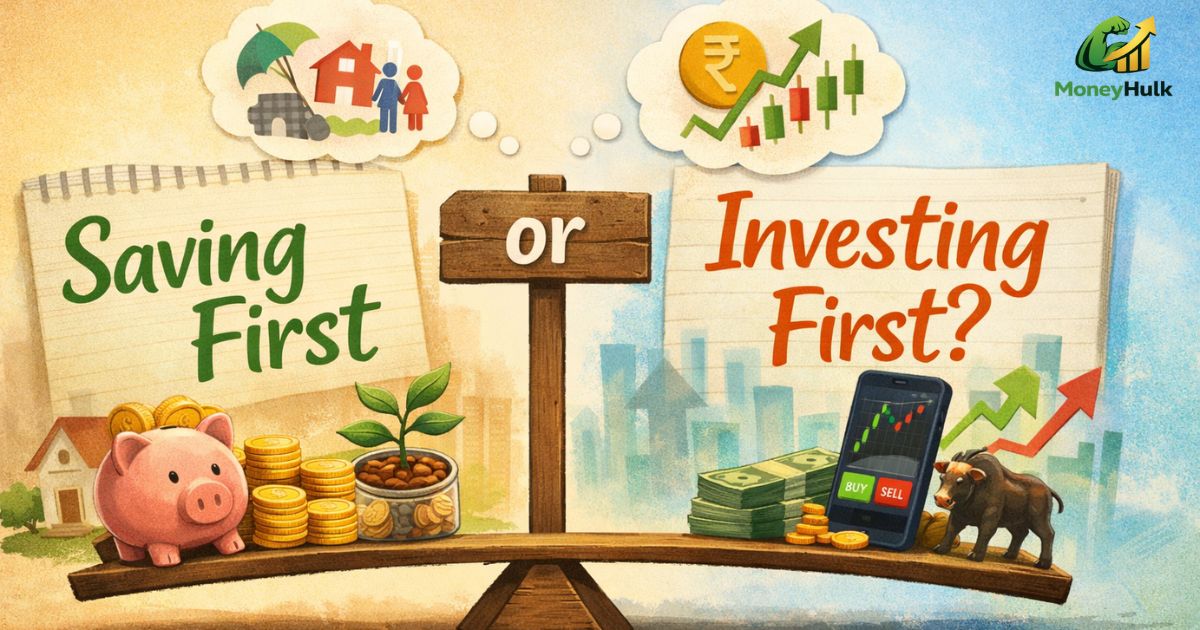
Most people in India don’t start their money journey with investing.
They start with confusion.
You hear about mutual funds, stocks, SIPs, and “start early” advice from every direction.
Friends talk about returns. Social media talks about wealth.
And somewhere in between, a quiet question appears:
“Should I be saving first… or am I already late?”
The truth is, many people try to invest before they feel financially steady.
Not because they are careless, but because no one clearly explains where saving fits in the money journey.
So they rush. They worry. And money starts feeling stressful instead of supportive.
Saving money is not a boring first step you must “get over with.”
It is the foundation that makes everything else work.
Without savings, investing feels risky and emotional.
With savings, investing feels calmer and more intentional.
This guide is written for ordinary Indian households — salaried employees, first-time earners, families with responsibilities.
No extreme rules. No guilt. No promises of quick wealth.
Just a simple, honest explanation of why saving comes first, how much is enough, and how to build it quietly before you start investing.
1. “I Want to Invest, But I Have No Savings”
This is a sentence many Indians say quietly to themselves.
You open YouTube or Instagram and see people talking about SIPs, stocks, crypto, and “invest early to become rich.”
Your friends discuss mutual funds during lunch breaks.
Someone from your office casually says, “I started investing two years ago.”
And you think…
“I want to invest too.
But honestly, I don’t even have proper savings.”
Your salary comes in.
Then rent, EMIs, groceries, electricity bill, phone recharge, family expenses.
By the end of the month, the balance looks small — sometimes scary small.
So you feel stuck between two fears:
- Fear of not investing early
- Fear of not having enough money if something goes wrong
This confusion is very common.
And no — it doesn’t mean you are bad with money.
Here’s the truth most people don’t say clearly enough:
Wanting to invest before saving is not ambition.
It is anxiety.
Saving is not a sign that you are scared of risk.
Saving is a sign that you are preparing your base.
In India, life is unpredictable.
- Medical emergencies
- Family responsibilities
- Job changes
- Sudden expenses we never plan for
Without savings, investing feels stressful.
With savings, investing feels calm.
That’s why this guide exists.
Before talking about how to grow money,
we first need to talk about how to protect yourself.
And that protection starts with saving — quietly, slowly, and without guilt.
Let’s understand what saving really means, in simple Indian terms.
2. What Does “Saving Money” Really Mean? (In Simple Indian Terms)
When people hear the word saving, many imagine something extreme.
Some think it means:
- Never eating outside
- Saying no to small pleasures
- Locking money away and forgetting about it
That’s not what saving actually means.
In real life, saving money simply means this:
Keeping some money safe, accessible, and stress-free for your future self.
That’s it.
Saving is not about becoming rich.
Saving is about not panicking when life throws a surprise.
In the Indian context, saving usually looks like:
- Money in a savings bank account
- A fixed deposit kept aside for safety
- A recurring deposit where a small amount moves automatically every month
These are not exciting options.
And that’s exactly why they work.
Savings are meant to be:
- Stable (no daily ups and downs)
- Easy to access when needed
- Low risk, even if returns are small
Many people confuse saving with investing and expect high returns from savings.
That expectation only creates disappointment.
Here’s a simple way to remember the difference:
- Savings protect your life
- Investments grow your wealth
One is for peace of mind.
The other is for long-term growth.
Both are important — but they have different jobs.
If you try to make your savings “work hard” like investments,
you often end up taking risks you don’t fully understand.
And if you don’t save at all,
every investment decision feels scary.
Saving is your financial breathing space.
It gives you the confidence to think long-term.
Now that we’re clear on what saving really means,
let’s look at why saving should come before investing — always.
3. Saving vs Investing: Why the Order Matters More Than You Think
Most people don’t get into trouble because they invest badly.
They get into trouble because they invest too early.
On the surface, saving and investing look similar.
Both involve putting money aside.
But emotionally, they are very different.
Saving is calm.
Investing comes with ups and downs.
When you invest without savings, every market movement affects your mood.
- A small fall feels like a big loss
- News headlines create panic
- You keep checking your app again and again
This is not because you are weak.
It’s because you have no safety cushion behind you.
Now imagine the opposite situation.
You have:
- A few months of expenses saved
- Money kept aside for emergencies
- Confidence that bills are covered even if income is delayed
Suddenly, investing feels different.
- You don’t panic during market corrections
- You don’t sell in fear
- You can think long term
That’s the real reason the order matters.
Saving gives you time.
Investing needs patience.
Without savings, patience is impossible.
A very common Indian mistake is this:
“I’ll invest first. I’ll save later when income increases.”
In reality, what happens is:
- Market goes down
- Emergency comes
- Investments are sold at the worst time
This creates frustration and distrust in investing itself.
Here’s a simple rule that works quietly in the background:
Save first so you can invest peacefully.
Once your basic safety is taken care of,
investing stops feeling like a gamble
and starts feeling like a process.
In the next section, we’ll talk about something important —
why saving feels especially hard in India, and why you shouldn’t blame yourself for it.
4. Why Saving Is Hard in India (And It’s Not Your Fault)
If saving feels difficult, you are not alone.
For many Indians, saving is not just a personal habit.
It is tied to family, culture, and responsibilities.
Let’s be honest about a few realities.
The cost of living keeps rising.
- Rent goes up
- School fees increase
- Medical expenses are unpredictable
- Daily expenses quietly eat into income
On top of that, Indian households often carry shared responsibilities.
- Supporting parents
- Helping siblings
- Contributing to family functions
- Unexpected obligations that can’t always be avoided
Then there is social spending.
Weddings, festivals, gifts, travel — these are not luxuries in India.
They are emotional and cultural commitments.
So when someone says,
“Just save 30% of your income”
it can feel unrealistic, even irritating.
Here’s something important to hear:
Struggling to save does not mean you are careless with money.
It usually means:
- Your income has many directions to flow
- Your responsibilities are real
- You are doing the best you can with what you have
This is why guilt-based saving advice fails.
It makes people feel bad, not better.
Saving in India works only when it is:
- Flexible
- Kind to your lifestyle
- Adjusted to your reality
Even saving ₹1,000–₹3,000 consistently matters more than trying to save big amounts once in a while.
Small, steady saving builds confidence.
And confidence builds discipline.
In the next section, we’ll answer a very common question:
“How much should I actually save before I start investing?”
No pressure. Just clarity.
5. How Much Should You Save Before You Start Investing?
This is one of the most searched — and most misunderstood — questions.
Some people say,
“You must save one year of expenses.”
Others say,
“Three months is enough.”
Listening to all this can make you feel like:
“I’ll never be ready to invest.”
So let’s simplify this.
There is no perfect number.
There is only a comfortable range.
For most people in India, a good starting goal is:
3 to 6 months of essential expenses
Notice the words starting goal.
This is not a rule.
This is not a deadline.
This is a direction.
Now, what are essential expenses?
Think of things you cannot avoid even if income stops:
- Rent or home EMI
- Basic groceries
- Electricity and water bills
- School or college fees
- Basic transport and medical needs
This is not your lifestyle spending.
This is your survival spending.
If your monthly essential expenses are ₹30,000:
- 3 months = ₹90,000
- 6 months = ₹1,80,000
You don’t need to build this overnight.
Most people build it slowly, over time:
- A small amount every month
- Bonuses when they come
- Any unexpected extra income
The most important thing to remember:
Even one month of expenses saved is better than zero.
If you wait to be “perfectly ready,” you may never start.
Start where you are.
Build gradually.
Invest peacefully when the pressure reduces.
In the next section, we’ll talk about where to keep this saved money safely in India, without taking unnecessary risks.
6. Where Should You Keep Your Savings in India?
Once you start saving, the next confusion appears quickly:
“Where should I keep this money?”
Some people keep everything in their main bank account.
Some lock it all in fixed deposits.
Some try to chase returns even with savings.
Let’s slow this down.
Money meant for savings has one clear job:
It should be safe and easy to access.
Not exciting.
Not high-return.
Just reliable.
Here are the most practical options for beginners in India.
Savings Bank Account
This is the simplest and most flexible option.
- Easy access anytime
- Useful for emergencies
- Low returns, but high peace of mind
Many people make one small mistake here —
they mix spending money and saving money in the same account.
A simple improvement:
- One account for daily expenses
- One separate account only for savings
This small separation makes a big psychological difference.
Fixed Deposits (FDs)
FDs are popular in India for a reason.
- Stable
- Predictable
- Easy to understand
They work well for:
- Emergency fund
- Short-term goals
- Money you don’t want to touch daily
You don’t need long lock-ins.
Short-term or flexible FDs are enough in the beginning.
Recurring Deposits (RDs)
RDs are great for people who struggle with discipline.
- Small amount auto-debited every month
- No thinking required
- Builds habit quietly
Even ₹1,000 or ₹2,000 per month adds up over time.
You may hear about other options too.
Those can come later.
For now, remember this simple idea:
Savings money should help you sleep better at night.
If an option makes you worry, check prices daily, or fear losses —
it doesn’t belong in your savings bucket.
In the next section, we’ll talk about simple saving habits that actually work in real Indian households, without extreme rules or guilt.
7. Simple Saving Habits That Actually Work (Without Killing Your Life)
Most people don’t fail at saving because they don’t know how.
They fail because the advice they hear is too extreme.
Saving does not require you to stop living.
It requires you to be slightly intentional.
Here are saving habits that work quietly in real Indian households.
Save First, Spend Later
The moment salary comes in, move a small amount to savings.
- Even before bills
- Even before shopping
This could be:
- ₹1,000
- ₹3,000
- ₹5,000
The amount matters less than the habit.
What you don’t see, you don’t spend.
Keep Savings Separate
When savings sit in the same account as expenses,
they slowly disappear.
A separate savings account creates friction.
You pause before touching it.
That pause protects your future self.
Automate Small Amounts
Automation removes emotion.
- Recurring deposit
- Auto-transfer to savings account
Once set, you don’t need motivation every month.
Use Extra Money Wisely
Festival bonuses, incentives, tax refunds —
these feel like “extra” money.
Instead of spending all of it:
- Save a part
- Enjoy a part
Balance matters.
Don’t Chase Perfection
Some months you’ll save less.
Some months you’ll save nothing.
That’s okay.
Consistency over time beats intensity for one month.
Saving works best when it fits into your life,
not when it fights your lifestyle.
In the next section, we’ll clear some common saving myths that silently stop people from even trying.
8. Common Saving Myths That Quietly Hold People Back
Many people don’t avoid saving because they are careless.
They avoid it because they believe things that aren’t true.
Let’s clear a few common myths — gently.
Myth 1: “I need a high salary to save”
This sounds logical, but it’s misleading.
People with higher salaries also increase their spending.
Saving is more about habits than income.
Many people saving ₹2,000 consistently are better off than people saving nothing on a ₹1 lakh salary.
Myth 2: “Saving small amounts is pointless”
Small savings are not useless.
They are training.
They build:
- Discipline
- Awareness
- Confidence
Big savings usually come later.
Myth 3: “Investing is always better than saving”
Investing and saving are not competitors.
Savings protect you.
Investments grow you.
Skipping protection to chase growth creates stress.
Myth 4: “Nothing bad will happen to me”
Life doesn’t send warnings.
Medical expenses, job gaps, family needs —
they arrive unannounced.
Saving is not pessimism.
It is preparation.
Myth 5: “I’ll start saving once my income increases”
Income increase doesn’t automatically create savings.
Habits do.
If you don’t save a little now,
you likely won’t save much later either.
Once these myths are cleared, saving feels less heavy.
Less scary.
More doable.
9. When Are You Finally Ready to Start Investing?
This is the point where many people feel impatient.
“I’ve been saving.
When do I actually start investing?”
There’s no announcement or perfect signal.
But there are signs that tell you you’re getting ready.
You may be ready to invest when:
- You have at least some emergency savings
- Your monthly expenses feel manageable
- A sudden bill doesn’t completely shake you
- You don’t feel desperate to “make money fast”
Notice something important here.
Readiness is not about amounts.
It’s about how you feel about money.
When savings exist:
- Market ups and downs feel tolerable
- You don’t check apps every hour
- You think in years, not weeks
This is when investing becomes a long-term habit, not a gamble.
Many people start investing while still building savings —
that’s okay too, as long as:
- Savings come first
- Investing amounts are small and calm
Think of savings as the ground beneath your feet.
Investing is the path ahead.
You don’t need to stop walking to strengthen the ground.
But you shouldn’t run without it.
10. Saving Is Not a Delay — It Is Self-Respect
Saving often feels invisible.
There are no screenshots to post.
No excitement to talk about.
No instant results to celebrate.
But quietly, saving changes how you live.
It gives you:
- The ability to handle emergencies without panic
- The freedom to say no when something feels risky
- The confidence to think long term
Saving is not about fear.
It is about respecting your future self.
Many people think they are “late” to investing.
They are not.
Starting without savings is not starting early —
it is starting anxious.
When you save first:
- You invest with clarity
- You take better decisions
- You sleep better
That peace is underrated, but powerful.
You don’t need to compare your journey with anyone else’s.
You don’t need to rush.
You don’t need to feel guilty for starting small.
Every rupee saved is a signal:
“I care about my stability.”
And from that stability, growth becomes natural.
When you’re ready, investing will be waiting.
Calm. Logical. And much less scary.

Sethuram Kishore is the founder of MoneyHulk and Worthview, with over 18 years of experience in SEO, digital marketing, and online publishing. Since launching Worthview in 2008, he has published hundreds of articles across finance, business, technology, and consumer topics. Through MoneyHulk, he shares practical, research-backed guides on personal finance, investing, banking, entrepreneurship, and wealth building.


