


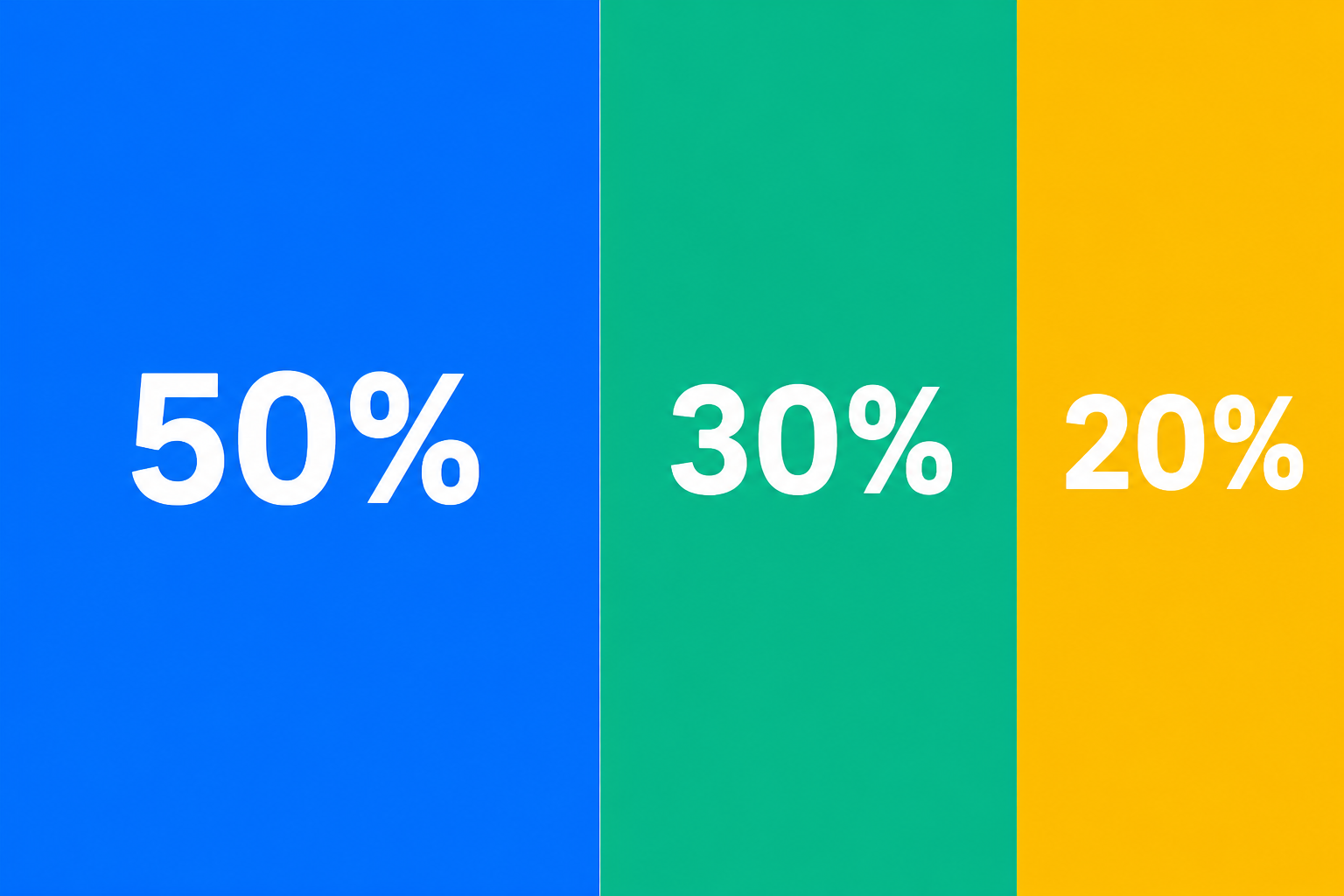
You’ve probably heard of the 50/30/20 rule. It’s one of the most talked-about budgeting methods on the internet — clean, simple, and very American.
But here’s the question nobody asks: does it actually make sense for someone earning a salary in India?
Spoiler: it kind of does — but with some important tweaks. Let’s break it down properly.
What Is the 50/30/20 Rule?
The 50/30/20 rule was popularised by US Senator Elizabeth Warren in her book All Your Worth. The idea is straightforward:
- 50% of your income goes to Needs (rent, groceries, utilities, EMIs)
- 30% of your income goes to Wants (eating out, Netflix, shopping, travel)
- 20% of your income goes to Savings & Investments
Simple. Clean. Easy to remember.
The problem? It was designed for an American income, American expenses, and an American lifestyle. India is a different story.
Let’s Test It on a Real Indian Salary
Say you earn ₹50,000 per month (take-home after tax). Here’s what the 50/30/20 rule would look like:
| Category | Percentage | Amount |
|---|---|---|
| Needs | 50% | ₹25,000 |
| Wants | 30% | ₹15,000 |
| Savings & Investments | 20% | ₹10,000 |
On paper, this looks totally reasonable. But the moment you live in a metro city, the math starts falling apart.
The Metro City Problem
If you’re renting in Mumbai, Delhi, Bengaluru, or Hyderabad, your rent alone can eat 40–50% of your salary. Add groceries, commuting, internet, phone bills, and any EMI — and you’ve easily crossed ₹25,000 before you’ve had a single “want.”
So the 50% needs bucket gets squeezed immediately.
Where the 50/30/20 Rule Works Well in India
To be fair, the rule does work — just not for everyone equally. Here’s when it makes sense:
Smaller cities and towns: If you live in Tier 2 or Tier 3 cities like Jaipur, Coimbatore, Bhopal, or Nagpur, your rent and living costs are significantly lower. The rule fits much better here.
Higher salaries: If you’re earning ₹80,000–₹1,00,000+ per month, the 50% needs bucket gives you genuine breathing room. You can comfortably cover all essentials and still have money for savings and fun.
Single professionals: Someone without dependents, no EMIs, and renting a modest place can follow this rule quite naturally.
Where It Breaks Down for Indians
1. The 30% “Wants” Bucket Is Way Too Generous
Most Indians — especially those just starting out — cannot afford to spend 30% of their salary on wants. At ₹50,000/month, that’s ₹15,000 on eating out, movies, and shopping. That’s a lot.
For most salaried Indians, the wants bucket realistically sits at 10–15%, not 30%.
2. 20% Savings Might Not Be Enough
In India, you don’t just save for yourself — there’s family responsibility, wedding planning, home buying, and parents’ medical care. The traditional American “20% into a 401k” model doesn’t translate well here.
Financial planners in India often recommend saving at least 25–30% of your income, especially if you start late or have big financial goals.
3. Taxes Are Already Deducted — Or Are They?
The original 50/30/20 rule is applied on post-tax income in the US. In India, if you’re a salaried employee, your TDS is deducted at source — so your take-home is already post-tax. But if you’re a freelancer or self-employed, you need to set aside money for advance tax separately, which the rule doesn’t account for.
4. It Ignores Indian Financial Instruments
PPF, NPS, ELSS, EPF — India has a rich ecosystem of tax-saving investment options. A good Indian budgeting strategy needs to incorporate these, not just a generic “save 20%” instruction.
The Indianised Version: The 40/20/30/10 Rule
Based on Indian financial realities, here’s a more practical adaptation:
| Category | Percentage | What It Covers |
|---|---|---|
| Needs | 40% | Rent, groceries, utilities, EMIs, transport |
| Savings & Investments | 30% | SIPs, PPF, FD, emergency fund, NPS |
| Wants | 20% | Eating out, travel, entertainment, subscriptions |
| Insurance & Taxes | 10% | Health insurance, term life, advance tax (for freelancers) |
This version does three things differently:
- Reduces needs to 40% — forces you to be intentional about fixed costs
- Bumps savings to 30% — reflects India’s higher financial responsibility load
- Shrinks wants to 20% — more realistic for most Indian incomes
- Adds an insurance & tax bucket — something the original rule completely ignores
How to Actually Apply This to Your Salary
Here’s a quick step-by-step to get started:
Step 1: Calculate your real take-home pay This is after TDS, EPF deduction, and any other deductions your employer makes. Look at your salary slip, not your CTC.
Step 2: List your fixed non-negotiable expenses Rent, EMIs, electricity, internet, groceries, commute. These are your needs. Be honest — don’t include “I like to eat out every weekend” as a need.
Step 3: Set your savings target first Before budgeting for wants, decide what you’ll invest. Automate a SIP or RD on salary day so the money leaves before you can spend it.
Step 4: Whatever’s left is your lifestyle budget This covers eating out, shopping, travel, and anything fun. If it feels tight, look at your needs first — that’s usually where the leakage is.
Step 5: Review every 3 months Your income and expenses change. Revisit your percentages quarterly and adjust.
Real Talk: What Percentage Should Indians Save?
Here’s a rough guide based on income levels:
| Monthly Take-Home | Suggested Savings Rate |
|---|---|
| ₹20,000 – ₹35,000 | 10–15% (even small amounts matter) |
| ₹35,000 – ₹60,000 | 20–25% |
| ₹60,000 – ₹1,00,000 | 25–30% |
| ₹1,00,000+ | 30–40% |
Even saving ₹2,000–₹3,000 a month consistently is better than saving nothing and waiting until you “earn more.”
The Bottom Line
The 50/30/20 rule is a great starting framework — but it was not designed with Indian salaries, Indian cities, or Indian financial goals in mind.
Use it as a mental model, not a rigid rule. The real goal isn’t to hit 50/30/20 exactly — it’s to spend less than you earn, save intentionally, and avoid lifestyle inflation.
If you’re in a metro city earning ₹50,000, saving even 15–20% is something to be proud of. If you’re earning more and living lean, push your savings rate higher.
The best budget is the one you actually stick to. Start somewhere, adjust as you go, and keep showing up.
Quick Summary
- The 50/30/20 rule splits income into needs (50%), wants (30%), and savings (20%)
- It was designed for the US — and struggles with Indian metro rents and family responsibilities
- A more practical Indian version is 40% needs / 30% savings / 20% wants / 10% insurance
- The savings rate should increase as your income grows
- Automating your savings is the single most powerful habit you can build
At MoneyHulk, we believe personal finance should feel personal — not like a one-size-fits-all formula. If you found this useful, explore our guides on building an EV charging business, how to start a business in 2026, and online income guide.