


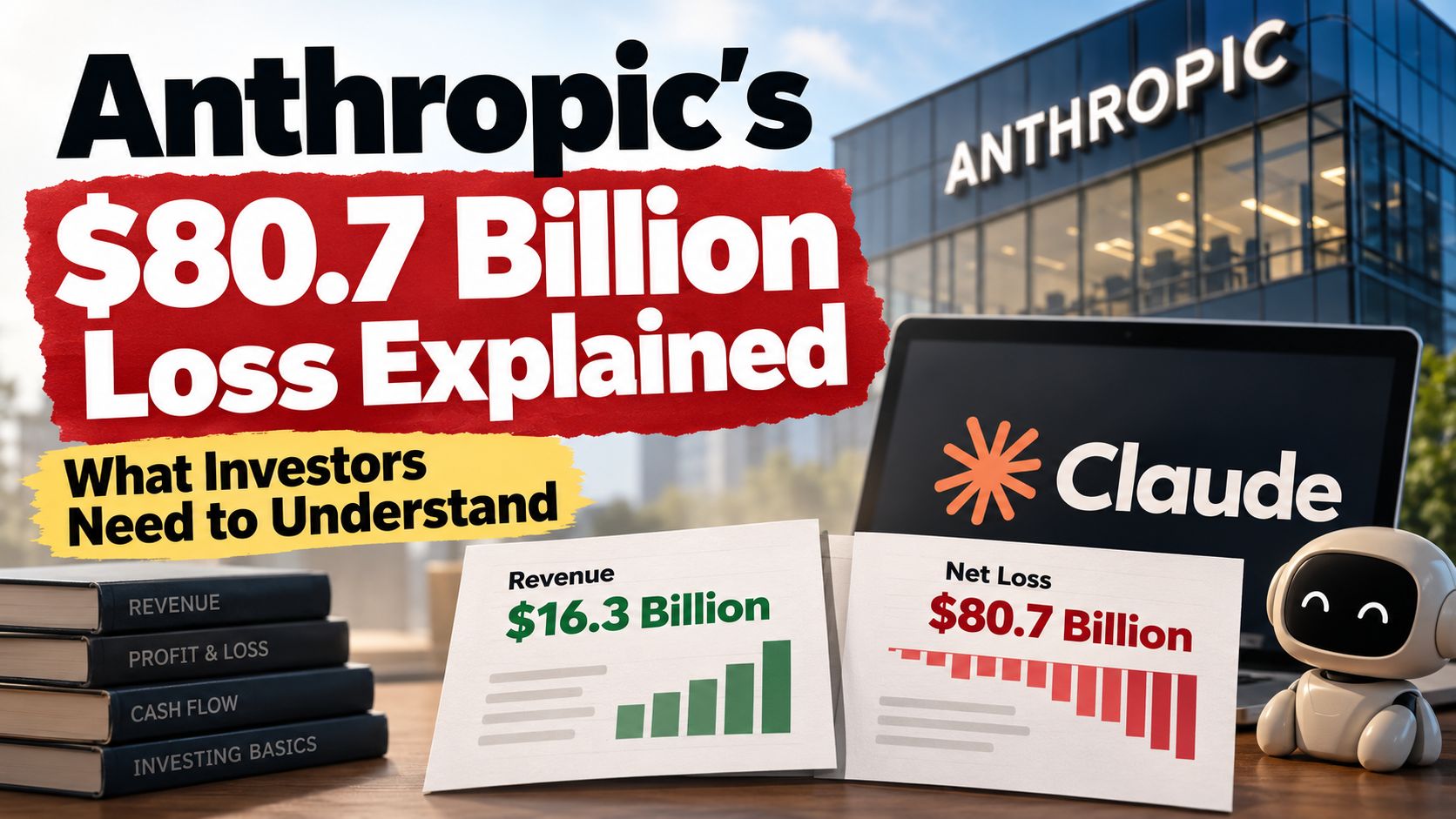
Anthropic is one of the companies at the centre of the AI boom. Its Claude models are attracting business customers, and its revenue is growing rapidly. Yet its public IPO filing revealed a number that sounds almost unbelievable: an $80.7 billion net loss in just six months.
How can a company generate billions in revenue and still report a loss several times larger than that revenue?
The answer lies in the difference between running a business, accounting for investments and financing, and managing cash. Understanding that difference is useful not only for following Anthropic’s potential IPO but also for reading the financial statements of companies you may consider investing in.
Let’s break down what the numbers actually tell us.
What Anthropic’s financial results reveal
According to Anthropic’s Form S-1 filed with the US Securities and Exchange Commission on October 26, 2026, the company reported the following figures for the six months ended June 30, 2026.
| Financial metric | First half of 2026 |
|---|---|
| Revenue | $16.286 billion |
| Total operating expenses | $16.979 billion |
| Operating loss | $693 million |
| Net loss | $80.748 billion |
| Loss from changes in the fair value of financing instruments | $72.388 billion |
At first glance, the net loss appears to suggest that Anthropic’s business is in serious trouble. But the operating results tell a different part of the story.
The company generated $16.3 billion in revenue, while its operating expenses exceeded that revenue by approximately $693 million. The much larger net loss emerged after accounting for items outside its operating expenses.
That distinction matters. A company’s net loss and the performance of its underlying business are related, but they do not always tell the same story.
Why did Anthropic report an $80.7 billion loss?
The largest contributor was a $72.4 billion loss arising from changes in the fair value of convertible notes, derivative liabilities and Simple Agreements for Future Equity, commonly known as SAFEs.
These are financing arrangements that can be used by growing companies to raise money before or alongside a future equity financing.
To understand why they matter, we need to look at how they work.
1. The accounting impact of convertible notes
A convertible note is a form of financing that starts as debt but can convert into shares under specified conditions.
For example, imagine a startup raises money through a convertible note when its valuation is relatively low. Later, the company’s valuation rises sharply.
Depending on the terms of the financing arrangement and the applicable accounting rules, the value of certain outstanding financial instruments or associated liabilities may increase. That increase can create an accounting loss even when the company has not paid out an equivalent amount of cash during that period.
Anthropic’s filing attributes much of its large fair-value loss to an increase in the value of its outstanding convertible promissory notes as its enterprise valuation rose.
This is the key to understanding the headline: a fair-value accounting loss is not automatically the same as cash leaving a company’s bank account.
However, that does not mean the financing arrangements are irrelevant. Their terms can affect future obligations, share conversion and dilution, depending on the instrument.
2. The remaining loss still matters
The $72.4 billion fair-value charge does not explain the entire $80.7 billion net loss.
Anthropic also reported approximately $8.8 billion in other net expenses, alongside other income and expenses. Investors should examine the detailed financial statements and notes rather than assume the entire difference is harmless or purely non-cash.
The sensible approach is to separate the unusual financing-related accounting effects from the costs of operating the business, while still examining the financial obligations behind those effects.
Is Anthropic’s core business profitable?
Not yet, based on its reported operating results for the first half of 2026.
Anthropic’s revenue reached $16.286 billion, but its total operating expenses were approximately $16.979 billion. That left an operating loss of $693 million.
Operating expenses included:
- Compute and infrastructure: $8.945 billion
- Personnel: $3.152 billion
- Sales, marketing and partnerships: $3.168 billion
- Other operating and administrative expenses: $1.714 billion
Running advanced AI models requires substantial computing resources. Developing models, hiring specialised employees and bringing products to business customers also costs money.
Revenue growth alone does not guarantee that these costs will eventually fall below revenue. Investors need to watch whether revenue continues to grow, how much it costs to generate that revenue and whether the company can improve its operating margins.
There is an encouraging detail, though. Anthropic’s operating loss narrowed from $2.135 billion in the first half of 2025 to $693 million in the first half of 2026, even as revenue increased substantially.
That suggests improvement in its reported operating result. It does not, by itself, prove that the company has reached sustainable profitability.
Why investors should look beyond net profit or loss
Anthropic’s results illustrate why one headline number is rarely enough to judge a business.
When analysing a company, investors should examine three things together.
1. Operating performance
Look at revenue, operating expenses and operating profit or loss. These figures help explain whether the company’s ordinary business activities are moving towards profitability.
2. Cash flow
Accounting profit and cash flow are different measures. The cash flow statement shows how much cash the business generates or uses through operations, investing and financing.
A company can report an accounting loss without losing the same amount of cash. Equally, a company can report an accounting profit while struggling to generate cash.
For Anthropic, investors should examine operating cash flow, capital expenditure and financing inflows separately. The $80.7 billion net loss should not be treated as its cash burn.
3. Financing obligations and dilution
Convertible notes, derivatives and other financing arrangements can affect a company’s future financial position. Investors should read the relevant notes to understand when obligations become payable, when instruments may convert into shares and how existing shareholders could be diluted.
This is particularly important when analysing young companies that raise substantial amounts of capital to fund expansion.
What does this mean for someone considering an AI IPO?
Anthropic’s financial results do not automatically make it a bad investment, nor does its rapid revenue growth automatically make it a good one.
The company’s reported operating loss narrowed significantly, but it still spends heavily on infrastructure and personnel. Its financing arrangements also create accounting complexity that investors need to understand.
Before evaluating any potential IPO, ask yourself:
- Is revenue growing faster than operating expenses?
- Is the operating loss narrowing consistently?
- Does the business generate cash from its operations?
- How much additional infrastructure spending will it need?
- What obligations and potential dilution arise from its financing arrangements?
- Does the proposed share price reasonably reflect the company’s financial performance and risks?
These questions are useful for evaluating companies in other sectors, too. The numbers may be less dramatic, but the principles remain the same.
The bottom line
Anthropic’s $80.7 billion net loss looks alarming until you examine what sits behind it. A $72.4 billion fair-value loss on financing instruments accounts for most of the headline figure, while its reported operating loss was $693 million.
That is a very different picture from a business losing $80.7 billion through its day-to-day operations. But it is not proof that Anthropic has solved its profitability challenge, either.
For investors, the lesson is straightforward: never judge a company by its revenue or net loss alone. Read the income statement, examine cash flow, understand financing arrangements and consider the price at which the shares are offered.
The most useful question is not simply how much a company lost. It is why it lost that amount, what it means for future cash flows and whether the business can eventually earn more than it spends.
Source: Anthropic’s preliminary Form S-1 registration statement filed with the US Securities and Exchange Commission on October 26, 2026. Figures are in US dollars and cover the six months ended June 30, 2026. The registration statement is preliminary, and its disclosures may change.
This article is for educational purposes only and is not investment advice.

Sethuram Kishore is the founder of MoneyHulk and Worthview, with over 18 years of experience in SEO, digital marketing, and online publishing. Since launching Worthview in 2008, he has published hundreds of articles across finance, business, technology, and consumer topics. Through MoneyHulk, he shares practical, research-backed guides on personal finance, investing, banking, entrepreneurship, and wealth building.


