
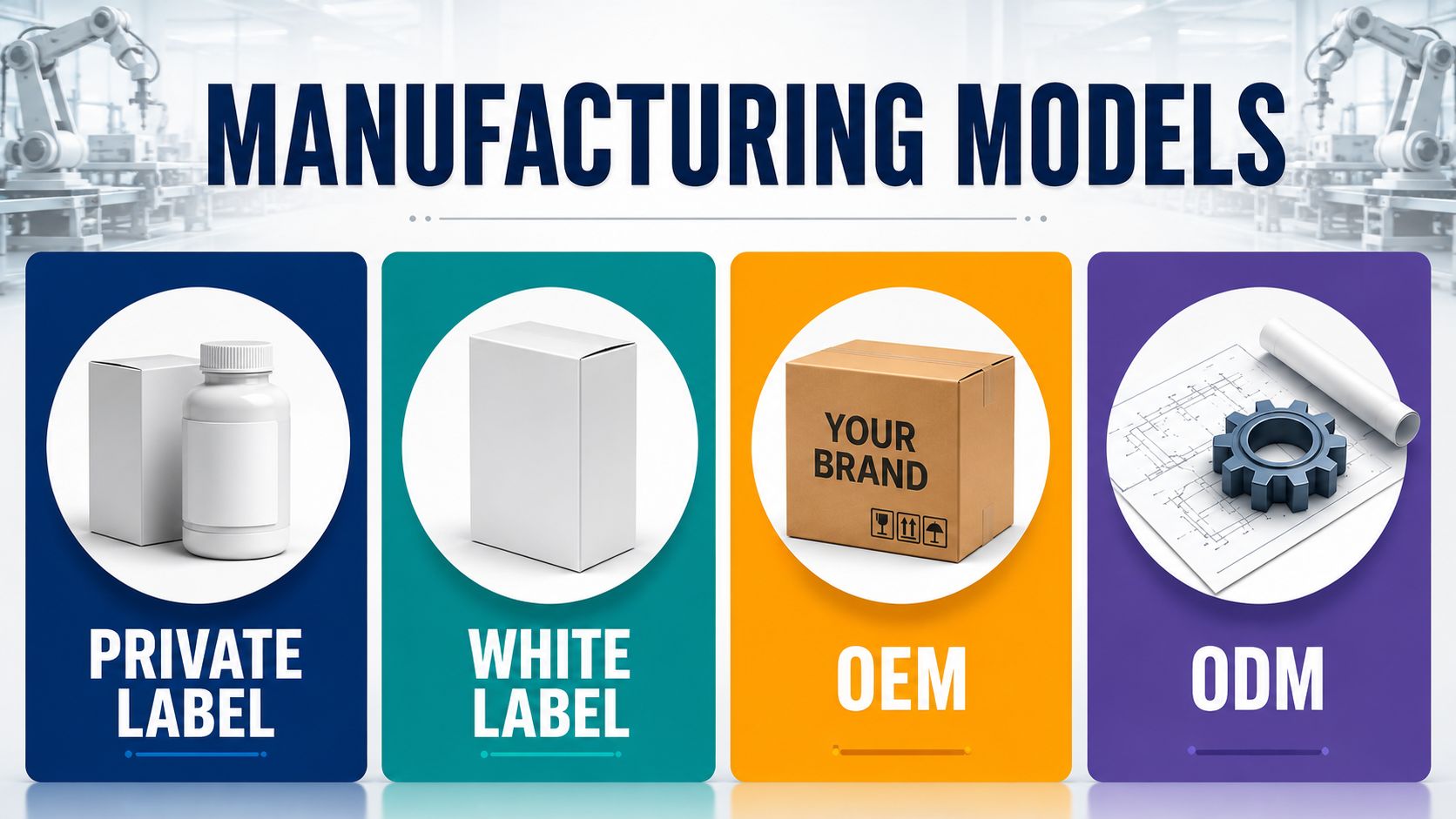
You do not need to own a factory to launch your own product brand. Thousands of Indian entrepreneurs are already building successful product businesses — from skincare to electronics — without manufacturing a single unit themselves. The secret is knowing which manufacturing model to use. In this guide, we break down the four main models — Private Label, White Label, OEM, and ODM — with real examples, startup costs, and a simple way to figure out which one suits you best.
| ⚡ Key Takeaways • Private Label: Buy a ready-made product, brand it as yours. Low entry cost. Good for beginners. • White Label: Same as private label but no product exclusivity — other brands sell the identical product. • OEM: You own the design; a manufacturer builds it to your exact specifications. Higher cost, full exclusivity. • ODM: Manufacturer owns the base design; you customise and brand it. Middle ground between cost and control. • Startup costs range from ₹50,000 (white label) to ₹20 lakh+ (OEM) depending on the model and category. • Indian sourcing (IndiaMart, TradeIndia) is cost-effective for beginners. Global sourcing (Alibaba) unlocks wider variety. • All models allow you to build and own your brand — without owning a factory. |
| Manufacturing Model | Famous Companies | Example |
|---|---|---|
| Private Label | Costco (Kirkland Signature), Walmart (Great Value), Target (Good & Gather), Amazon (Amazon Basics), Tesco | Costco sells Kirkland coffee manufactured by a third-party but branded as Kirkland. |
| White Label | Shopify merchants, beauty brands, supplement brands, SaaS companies | A generic vitamin manufacturer sells the same formula to dozens of brands with different labels. |
| OEM (Original Equipment Manufacturer) | Apple (Foxconn), Dell, HP, Cisco, Sony, Nike | Apple designs the iPhone, while Foxconn manufactures it according to Apple’s specifications. |
| ODM (Original Design Manufacturer) | Xiaomi ecosystem brands, Anker (selected products), Lenovo (some accessories), TCL, many consumer electronics brands | TCL manufactures TVs that are sold under various international brands. |
What Is a Manufacturing Model and Why Does It Matter?
A manufacturing model is the arrangement between you (the brand owner) and the factory that makes your product. It defines who designs the product, who owns the formula or blueprint, how much you can customise it, and what it will cost you to get started.
Choosing the wrong model is one of the most common — and expensive — mistakes new product entrepreneurs make. Arjun, a 27-year-old from Pune who wants to launch a skincare brand, does not need to build a lab. But he does need to know whether to go with a private label manufacturer or invest in an OEM relationship. The difference could mean ₹1 lakh versus ₹15 lakh in upfront costs.
Why the Right Model Can Make or Break Your Business
The model you choose affects your startup capital requirement, your product exclusivity, your time to market, your ability to compete on price, and your long-term brand positioning. A first-time entrepreneur selling on Amazon India has very different needs from an established D2C brand launching a custom product line. This guide helps you find your fit.
Easy way to remember
- Private Label → “My Brand, Their Product” (Costco, Amazon Basics)
- White Label → “Same Product, Many Brands” (Supplements, cosmetics, SaaS)
- OEM → “My Design, Their Factory” (Apple, Dell, Sony)
- ODM → “Their Design, My Brand” (Many electronics and home appliance brands)
Private Labelling — Sell Your Brand, Skip the Factory
Private labelling is the most popular starting point for new product entrepreneurs in India. You find a manufacturer who already makes a product, buy it in bulk, put your brand name and packaging on it, and sell it as your own.
How Private Labelling Works
- Find a manufacturer who makes your product category (e.g., face serum, protein supplement, notebook)
- Request samples and verify quality
- Negotiate minimum order quantity (MOQ) and price per unit
- Design your own logo, label, and packaging
- Place your order — the manufacturer produces and ships to you
- List and sell under your brand name on Amazon, Meesho, your own website, or offline
Real Example — Indian Context
| 🧴 Arjun’s Skincare Brand Arjun wants to launch a face moisturiser. He finds a cosmetics manufacturer on IndiaMart in Ahmedabad who already makes a quality moisturiser base. He orders 500 units at ₹80/unit, designs a premium label, and sells it under his brand “GlowRoute” at ₹349 on Amazon. He never touched a mixing machine. He just built a brand on top of an existing product. |
Startup Cost — Private Labelling in India
| Cost Component | Domestic (India) | Global (Alibaba/China) |
| MOQ (minimum order) | ₹25,000 – ₹80,000 | ₹40,000 – ₹1,20,000 |
| Label & packaging design | ₹5,000 – ₹20,000 | ₹5,000 – ₹20,000 |
| Branding (logo etc.) | ₹3,000 – ₹15,000 | ₹3,000 – ₹15,000 |
| Import duties (global only) | Not applicable | ₹10,000 – ₹40,000 |
| Total estimated range | ₹35,000 – ₹1,20,000 | ₹60,000 – ₹2,00,000 |
Who Should Choose Private Labelling?
- First-time entrepreneurs with a budget of ₹50,000 to ₹2 lakh
- Sellers who want to launch quickly (4–8 weeks to market)
- Anyone testing a product category before committing to custom manufacturing
- Amazon, Meesho, or D2C sellers who want brand ownership without R&D investment
Private Labelling — Pros and Cons
| ✅ Pros | ❌ Cons |
| Low startup cost | Competitors may sell the identical product |
| Fast time to market | Limited product differentiation |
| No product design needed | Less control over formula or quality |
| Easy to test and pivot | MOQ still required upfront |
| Full brand ownership | Manufacturer can supply your rivals too |
Also read, How to Find International Buyers for Your Export Business
White Labelling — The Fastest Way to Launch a Product
White labelling is very similar to private labelling — and the two terms are often used interchangeably. The key difference is that in white labelling, the manufacturer produces one standard product and sells it to many brands simultaneously. Every brand just puts their own label on the same product.
How White Labelling Works
- Manufacturer produces a generic, ready-to-sell product at scale
- Multiple brands (including you) buy the same product
- Each brand applies their own packaging, label, and pricing
- You sell it under your brand — but so do five other sellers
Real Example — Indian Context
| 💊 Supplement Seller on Meesho A nutritional supplement factory in Surat produces one standard whey protein formula. They supply the same product to 12 different brands — each selling it under a different name on Flipkart and Meesho. One brand calls it “ProFit Whey”, another calls it “MuscleMax”. Same powder inside, different packaging outside. |
Startup Cost — White Labelling in India
| Cost Component | Domestic (India) | Global (Alibaba/China) |
| MOQ (minimum order) | ₹15,000 – ₹50,000 | ₹30,000 – ₹90,000 |
| Label & packaging design | ₹3,000 – ₹10,000 | ₹3,000 – ₹10,000 |
| Import duties (global only) | Not applicable | ₹8,000 – ₹30,000 |
| Total estimated range | ₹20,000 – ₹60,000 | ₹40,000 – ₹1,30,000 |
Who Should Choose White Labelling?
- Sellers with a very tight budget (under ₹50,000 to start)
- Resellers or distributors building a branded product line quickly
- Entrepreneurs who prioritise speed over product exclusivity
- Businesses testing a market before investing in differentiated products
White Labelling — Pros and Cons
| ✅ Pros | ❌ Cons |
| Lowest startup cost of all four models | Zero product exclusivity |
| Fastest time to market | Identical product sold by many competitors |
| No MOQ pressure (sometimes) | Very hard to build long-term brand loyalty |
| Easy to switch products | Price wars are common |
| No design or R&D investment | Manufacturer controls product quality entirely |
OEM (Original Equipment Manufacturer) — Build It Your Way
OEM stands for Original Equipment Manufacturer. In this model, you own the product design, formula, or blueprint — and you hire a manufacturer to build it exactly to your specifications. The manufacturer is just the builder; you are the creator.
This is the model used by most established product brands. Think of how Apple designs its products and then contracts Foxconn to manufacture them. In India, this model is increasingly accessible to serious D2C entrepreneurs and growing brands.
How OEM Works
- You develop a product concept, design, or formula (in-house or with a consultant)
- You approach manufacturers with your detailed specifications
- The manufacturer produces the product exclusively to your blueprint
- You own the IP (intellectual property) — the design is yours
- You brand and sell the finished product
Real Example — Indian Context
| ⌚ Smartwatch Brand from Hyderabad A Hyderabad-based tech entrepreneur designs a smartwatch with specific health-tracking features tailored for Indian users — including a regional language interface and an SpO2 sensor. He approaches an OEM factory in Noida with detailed technical specs. The factory builds the watch exclusively for his brand. No other brand sells this watch. He owns the design and has filed for a patent. |
Startup Cost — OEM in India
| Cost Component | Domestic (India) | Global (China/Taiwan) |
| Product design & engineering | ₹1,00,000 – ₹5,00,000 | ₹80,000 – ₹3,00,000 |
| Prototyping & sampling | ₹50,000 – ₹2,00,000 | ₹40,000 – ₹1,50,000 |
| MOQ (first production run) | ₹3,00,000 – ₹10,00,000 | ₹2,00,000 – ₹8,00,000 |
| IP / trademark / patent filing | ₹20,000 – ₹1,00,000 | ₹20,000 – ₹1,00,000 |
| Total estimated range | ₹5,00,000 – ₹20,00,000+ | ₹3,50,000 – ₹15,00,000+ |
Who Should Choose OEM?
- Entrepreneurs with an original product idea or proprietary formula
- Brands with a budget of ₹5 lakh and above
- Founders who want full product exclusivity and no competition on the same product
- Businesses planning to build long-term IP and defensible brand assets
- D2C brands targeting premium positioning
OEM — Pros and Cons
| ✅ Pros | ❌ Cons |
| 100% product exclusivity | High upfront investment required |
| Full IP and design ownership | Long lead time (3–9 months for first run) |
| Strong brand differentiation | Requires technical knowledge or consultants |
| Premium pricing power | High MOQs typical |
| Best for long-term brand building | Risk is higher if product does not sell |
Read, How to Start an Export Business in India: The Ultimate Step-by-Step Guide
ODM (Original Design Manufacturer) — Customise Without Starting From Scratch
ODM stands for Original Design Manufacturer. Here, the manufacturer already has existing product designs. You pick a design you like, request modifications — colour, features, packaging, minor functional tweaks — and brand the final product as yours.
ODM sits between OEM and private labelling. You get more customisation than private labelling but without the cost and complexity of designing from scratch like in OEM.
How ODM Works
- Browse the manufacturer’s existing product catalogue
- Select a base product that fits your category
- Request customisations — colours, materials, minor features, logo placement
- Manufacturer modifies the existing design and produces your version
- You brand and sell the product — with partial exclusivity on your version
Real Example — Indian Context
| 🎧 TWS Earbuds Brand from Chennai Priya wants to launch wireless earbuds under her brand. She contacts an ODM factory in Shenzhen. She picks their existing TWS earbud base model, requests a custom colour (matte black), her logo on the case, and active noise cancellation added. Within 6 weeks she has a product that looks and feels unique — without engineering it from scratch. |
Startup Cost — ODM in India
| Cost Component | Domestic (India) | Global (China/Shenzhen) |
| Customisation & sampling fee | ₹20,000 – ₹80,000 | ₹15,000 – ₹60,000 |
| MOQ (first production run) | ₹1,00,000 – ₹4,00,000 | ₹80,000 – ₹3,00,000 |
| Branding & packaging design | ₹10,000 – ₹30,000 | ₹10,000 – ₹30,000 |
| Import duties (global only) | Not applicable | ₹20,000 – ₹80,000 |
| Total estimated range | ₹1,30,000 – ₹5,00,000 | ₹1,25,000 – ₹4,50,000 |
Who Should Choose ODM?
- Entrepreneurs with a budget of ₹1.5 lakh to ₹5 lakh
- Those who want product customisation without full design investment
- Electronics, accessories, and consumer goods sellers
- Brands that want partial differentiation from competitors
- Anyone who found a great base product but wants it to feel more “theirs”
ODM — Pros and Cons
| ✅ Pros | ❌ Cons |
| Lower cost than OEM | Design IP belongs to manufacturer, not you |
| Faster than OEM (design exists) | Limited exclusivity — others may use same base |
| More differentiation than private label | Customisation options can be restricted |
| Good balance of cost vs. control | Quality depends on manufacturer’s base product |
| Access to proven product designs | Harder to patent or protect your version |
Private Label vs White Label vs OEM vs ODM — Side-by-Side Comparison
| Feature | Private Label | White Label | OEM | ODM |
| Who designs the product? | Manufacturer | Manufacturer | You | Manufacturer |
| Product exclusivity | Partial | ❌ None | ✅ Full | Partial |
| Customisation level | Low | None | High | Medium |
| Startup cost (India) | ₹35K–₹1.2L | ₹20K–₹60K | ₹5L–₹20L+ | ₹1.3L–₹5L |
| Time to market | 4–8 weeks | 2–4 weeks | 3–9 months | 6–12 weeks |
| IP ownership | Brand only | Brand only | ✅ Full IP | Brand only |
| Best for | Beginners | Fast launchers | Established brands | Growing brands |
| Competition risk | Medium | High | Low | Medium |
Which Manufacturing Model Is Right for You?
There is no single “best” model. The right choice depends on your budget, your goals, your product category, and how much competitive differentiation you need. Here is a simple breakdown based on where Arjun — and entrepreneurs like him — actually stand.
If Your Budget Is Under ₹1 Lakh
White labelling or private labelling is your path. Both let you launch a branded product with limited capital. White labelling is faster and cheaper; private labelling gives you slightly more packaging control. Pick a product category with proven demand — supplements, skincare, stationery, or home goods — and test the market before scaling.
If Your Budget Is ₹1–5 Lakh
ODM becomes viable. You can source a quality base product, customise it meaningfully, and build a brand that looks genuinely different from generic sellers. Electronics accessories, personal care devices, and lifestyle products work well here. Global ODM sourcing via Alibaba opens up more options at this budget.
If Your Budget Is ₹5–20 Lakh
OEM is now within reach, especially for domestic Indian manufacturing. You can develop a proprietary product, protect it, and build a brand with real IP behind it. This is the route for founders who want to scale seriously and eventually raise funding or build an acquirable brand asset.
If You Already Have a Product Idea or Formula
Go OEM. If you have a unique idea — whether it is a food recipe, a fitness product design, or a skincare formula — protect it with a trademark or patent and find an OEM manufacturer to bring it to life. Your idea is your moat.
Quick Decision Guide
| 🧭 Which Model Should You Pick? → No product idea + small budget = White Label → No product idea + want brand control = Private Label → Existing product idea + want customisation + medium budget = ODM → Unique product idea or formula + serious budget + want exclusivity = OEM When in doubt, start with Private Label. Test. Learn. Then upgrade your model as you grow. |
Where to Find Manufacturers in India and China
Indian Sourcing Platforms and Trade Directories
- IndiaMart (indiamart.com) — India’s largest B2B marketplace. Search by product category and filter by verified suppliers.
- TradeIndia (tradeindia.com) — Good for bulk manufacturers across categories including food, pharma, and textiles.
- Udyam / MSME Directory — Find registered small manufacturers by state and product category.
- Industry-specific trade fairs — Cosmoprof India (beauty), ELECRAMA (electronics), India International Trade Fair.
Global Sourcing — Alibaba and Beyond
- Alibaba (alibaba.com) — The largest global B2B sourcing platform. Filter by “Trade Assurance” and “Verified Supplier” badges.
- Global Sources (globalsources.com) — Strong for electronics and consumer goods from Taiwan and China.
- Made-in-China (made-in-china.com) — Good alternative to Alibaba for hardware and industrial products.
Important: When importing from China, factor in Basic Customs Duty (BCD), IGST, and handling charges. These can add 20–40% to your landed cost depending on the product category. Always check HSN codes and applicable duty rates on the CBIC portal before placing orders.
What to Check Before Signing with Any Manufacturer
- Request physical samples before any bulk order — never skip this step
- Check certifications relevant to your category (FSSAI for food, BIS for electronics, ISO 9001 for general quality)
- Review MOQ, payment terms, and lead times in writing
- Verify GST registration for Indian suppliers; request a copy of their GSTIN
- For global suppliers, check Trade Assurance or escrow options before transferring money
- Get an NDA (Non-Disclosure Agreement) signed before sharing your product specifications
Legal and Compliance Basics Before You Start
Before you sell a single unit under your brand, a few legal and compliance steps are non-negotiable in India. Skipping these can lead to account bans, GST penalties, or losing your brand name to a competitor.
Trademark Registration for Your Brand
Register your brand name and logo as a trademark under the Trade Marks Act, 1999. Apply on the IP India portal (ipindia.gov.in). A TM application costs ₹4,500 for individuals and small enterprises. Once filed, you can use the ™ symbol immediately. Full registration typically takes 18–24 months but your priority date is locked from the day of filing.
MSME / Udyam Registration
Register your business on the Udyam portal (udyamregistration.gov.in). It is free, takes under 30 minutes, and gives you access to government schemes, priority lending, and legal protections as a micro or small enterprise. Most manufacturers and e-commerce platforms also prefer working with Udyam-registered sellers.
GST Registration for Product Sellers
If your annual turnover crosses ₹40 lakh (₹20 lakh for special category states), GST registration is mandatory. For e-commerce sellers, GST registration is required regardless of turnover — even for ₹1 of sales on Amazon or Flipkart. Register on the GST portal (gst.gov.in) and ensure your manufacturer provides GST invoices for input tax credit.
Category-Specific Licences — Brief Overview
- Food & Supplements: FSSAI licence or registration required before manufacturing or selling
- Electronics: BIS certification required for many categories under the Electronics and IT Goods Order
- Cosmetics: Must comply with Drugs and Cosmetics Act; state-level licence may be required for manufacturing
- Ayurvedic Products: Requires AYUSH approval for manufacturing and labelling compliance
FAQs — Manufacturing Models for Entrepreneurs in India
What is the difference between private label and white label?
Private labelling and white labelling are similar but not identical. In private labelling, you may have some packaging exclusivity and the manufacturer may limit how many brands they supply. In white labelling, the manufacturer sells the exact same product to multiple brands with no restrictions. The core product is identical in both cases — the difference is exclusivity.
Which manufacturing model is cheapest to start with in India?
White labelling has the lowest entry cost, with many Indian manufacturers accepting orders from ₹15,000 to ₹50,000. Private labelling is a close second. OEM is the most expensive model and typically requires a minimum of ₹5 lakh to get started, factoring in design, sampling, and production costs.
Can I start a private label business on Amazon India with ₹1 lakh?
Yes, ₹1 lakh is a reasonable starting budget for a private label brand on Amazon India. You can cover your MOQ (minimum order quantity), basic packaging design, and initial Amazon seller account setup within this budget. Categories like skincare, supplements, stationery, and home care work well at this investment level.
What does OEM mean in business?
OEM stands for Original Equipment Manufacturer. In the context of product businesses, it means you own the product design or specifications, and you hire a factory to manufacture it for you. The factory is the OEM — they are manufacturing your original design. You retain full ownership of the intellectual property and brand.
Is it legal to private label products in India?
Yes, private labelling is completely legal in India. You must ensure your product complies with all category-specific regulations (FSSAI for food, BIS for electronics, etc.), display all required labelling information (ingredients, manufacturer details, MRP, batch number), and register your brand as a trademark to protect it. Always get a proper manufacturing agreement signed with your supplier.
How do I find private label manufacturers in India?
The best platforms to find private label manufacturers in India are IndiaMart and TradeIndia. Search for your product category with terms like “private label manufacturer” or “contract manufacturing.” Always request samples before placing a bulk order, verify the supplier’s GST registration, and check for relevant certifications like FSSAI or ISO depending on your product category.
What is ODM and how is it different from OEM?
ODM stands for Original Design Manufacturer. In ODM, the manufacturer already has existing product designs that you can choose from and customise. In OEM, you bring your own design to the manufacturer. ODM is faster and cheaper than OEM but gives you less exclusivity and control. OEM is better if you have a unique idea you want to protect; ODM is better if you want differentiation at a lower cost.
Conclusion — Choose Your Model, Start Your Brand
You do not need a factory. You do not need a product design team. And you do not need crores of rupees to launch a product brand in India. What you do need is clarity on which manufacturing model fits your budget, your goals, and your timeline.
If you are just starting out, white labelling or private labelling gets you to market fast with minimal risk. As you grow and understand your customers better, ODM lets you differentiate without breaking the bank. And when you are ready to build something truly unique and defensible, OEM is the path that turns your idea into a brand with real IP behind it.
Arjun from Pune does not need to wait until he has ₹10 lakh saved. He can start with a private label moisturiser at ₹80,000, test the market on Amazon, and upgrade his model as his brand grows. That is exactly how most successful Indian D2C brands started.
| ➡️ Next Steps for You • Decide your starting budget and pick a model using the guide above. • Search IndiaMart or Alibaba for manufacturers in your product category. • Order samples from at least 3 suppliers before committing. • Register your brand on IP India before your first bulk order. • Get your GST registration and MSME/Udyam certificate ready before you start selling. |

Sethuram Kishore is the founder of MoneyHulk and Worthview, with over 18 years of experience in SEO, digital marketing, and online publishing. Since launching Worthview in 2008, he has published hundreds of articles across finance, business, technology, and consumer topics. Through MoneyHulk, he shares practical, research-backed guides on personal finance, investing, banking, entrepreneurship, and wealth building.


