


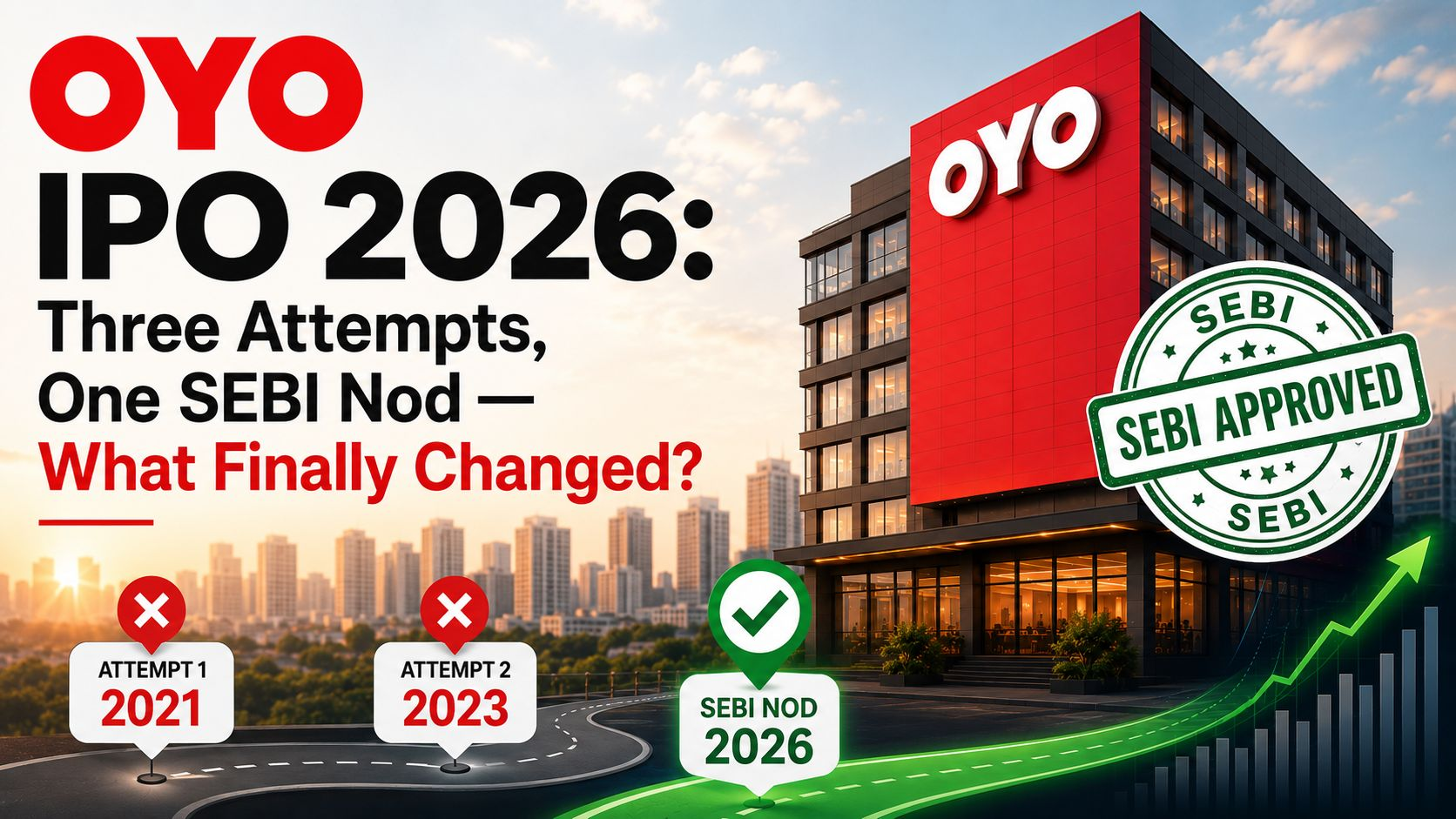
OYO’s IPO journey is one of the most dramatic stories in Indian startup history. The company filed for a public listing in 2021, pulled back, refiled in 2023, withdrew again, and now — in 2026 — its parent company Prism has finally received SEBI’s nod for a ₹6,650 crore IPO.
But the real question for investors is not just what the IPO looks like. It is: why did the first two attempts fail — and what is genuinely different this time?
This article breaks down all three attempts, what went wrong each time, and the key changes that make this third attempt look more serious than the previous two.
OYO’s first two IPO attempts failed due to regulatory concerns, massive losses, poor corporate governance, and investor pressure to fix the business first. The third attempt in 2026 is backed by 12 consecutive profitable quarters, a 172% jump in net profit to ₹623 crore in FY25, a cleaner balance sheet, and SEBI approval via the confidential filing route. The IPO targets a valuation of $7–8 billion.

The First Attempt (2021): Too Big, Too Fast, Too Broken
In October 2021, OYO filed its first Draft Red Herring Prospectus (DRHP) with SEBI. The IPO aimed to raise ₹8,430 crore — one of the largest startup IPO filings in India at the time — and was targeting a valuation of $11–13 billion.
It did not go well.
Why SEBI Sent It Back
SEBI returned the DRHP in January 2023 — 15 months after it was filed — with serious concerns:
- OYO’s Key Performance Indicators (KPIs) were unclear or hard to verify
- The company was facing multiple outstanding litigations
- Corporate governance red flags — including questions about related-party transactions
- Going-concern assumptions were questioned due to deep losses
- Valuation at $11 billion was seen as inflated with no profit to justify it
At the time, OYO had burned through billions of dollars in its chase for global scale. It had expanded aggressively to 80+ countries, hired thousands, and signed hotel deals at breakneck pace — only to reverse many of those moves when COVID hit and the cash ran out.
SoftBank, which owned around 46% of OYO, had already marked down the company’s valuation from $9 billion to $2.7 billion by 2022. The $11 billion IPO target was completely out of step with market reality.
The Second Attempt (2023–24): Smaller, But Still Not Ready
After getting feedback from SEBI, OYO refiled a revised DRHP in April 2023. This time, the size was much smaller — 40–60% lower than the original filing — and the valuation target was slashed dramatically.
What Changed in the Second Filing
- IPO size reduced to approximately ₹2,500 crore (vs ₹8,430 crore earlier)
- Valuation expectation dropped to around $1.5 billion — a fraction of the 2021 target
- Used the confidential filing route to reduce public pressure during review
- Financial statements were restated and updated
Why It Was Withdrawn Again (May 2024)
Despite the smaller size, the second attempt also fell apart. In May 2024, OYO withdrew the application. The reasons:
- Lender-related concerns and a bond-buyback transaction complicated the process
- SoftBank, the largest shareholder, was not supportive of listing at the time
- Profitability was still fragile — the company had only just crossed into profit
- Market conditions were volatile — not ideal for a startup IPO
Instead of listing, OYO chose to raise ₹600–700 crore from high-net-worth investors privately. It also undertook significant capital restructuring — including a stock split and bonus share issue — to prepare for a future listing.
The back-to-back failures did real damage. Retail investors who tracked OYO’s unlisted shares saw the price swing wildly. Every delay also meant more pressure on Ritesh Agarwal, who had personally taken a $2.2 billion loan in 2019 and needed a successful exit event to manage it.
The Third Attempt (2025–26): What Is Actually Different?
When Prism (OYO’s rebranded parent) filed confidentially in December 2025 and received SEBI’s nod in June 2026, the market reaction was noticeably different from the previous two times — cautious optimism rather than hype or scepticism.
Here is why this attempt carries more credibility:
1. Consistent Profitability — Not Just One Quarter
The single biggest difference from 2021 and 2023 is the profit track record. OYO is no longer a company showing signs of turning around. It has turned around.
| Metric | FY23 | FY24 | FY25 |
| Net Profit (PAT) | Loss | ₹229 Cr | ₹623 Cr |
| Revenue | ~₹4,200 Cr | ~₹5,200 Cr | ₹6,463 Cr |
| Adj. EBITDA Growth | — | Base year | +27% YoY |
| EPS (USD) | — | $0.36 | $0.93 |
12 consecutive quarters of EBITDA profitability. A 172% jump in net profit in a single year. Revenue growing 20% year-on-year. Moody’s even upgraded OYO’s credit rating based on these improvements.
2. The Valuation Has Been Reset to Reality
In 2021, OYO chased an $11 billion valuation with no profits to show. Today, the target is $7–8 billion — still high, but anchored in actual earnings. The implied P/E on ₹623 crore profit is around 90–100x at this valuation, which is aggressive — but far more defensible in a market context than the 2021 numbers.
3. Global Revenue Mix Has Shifted
India now accounts for only 30% of Prism’s revenue. The US contributes another 30%, Europe 10–15%, with the Gulf and South-East Asia making up the rest. The acquisition of G6 Hospitality (Motel 6 brand) in the US was a major driver of international growth.
This diversification matters for public market investors who are wary of single-market exposure.
4. Brand and Structure Have Matured
The parent company rebranded to Prism in 2025, reflecting a multi-brand, tech-enabled hospitality strategy. It now runs budget hotels (OYO), premium stays (Sunday Hotels), and short-term rentals alongside traditional inventory. This makes the IPO story less dependent on the ‘OYO brand’ — which carried reputational baggage — and more about a diversified travel-tech platform.
5. SoftBank Is Now On Board
One of the recurring blockers in 2023–24 was SoftBank’s resistance. The Japanese investor, which owns around 46% of Prism, had repeatedly asked management to hold off until earnings were stronger. With 12 profitable quarters and a 172% profit jump, that condition has been met. This shareholder alignment is critical for the IPO to actually go through.
OYO IPO 2026: Key Details at a Glance
| Parameter | Details |
| Parent Company | Prism (formerly Oravel Stays) |
| IPO Size | ₹6,650 crore (fresh issue) |
| Target Valuation | $7–8 billion |
| SEBI Status | Approved (June 2026) |
| Filing Route | Confidential DRHP (Dec 2025) |
| Listing Exchange | BSE and NSE (expected) |
| FY25 Revenue | ₹6,463 crore (~$753 million) |
| FY25 Net Profit | ₹623 crore (~$72 million) |
| Largest Shareholder | SoftBank (~46%) |
| Founder | Ritesh Agarwal |
Should You Invest? What to Watch Before Deciding
SEBI approval does not mean the IPO opens tomorrow. The company still needs to file the public DRHP, set a price band, and open the issue. Here is what to watch:
Reasons to Be Optimistic
- Consistent profitability over 3 years — no longer a one-quarter story
- Revenue growing at 20% YoY with global diversification
- India’s travel boom — domestic tourism hitting record numbers post-COVID
- Moody’s credit upgrade signals improved financial health
- Ritesh Agarwal has invested ₹1,380 crore of personal capital since 2024 — founder skin in the game
Risks to Keep in Mind
- Valuation of $7–8 billion implies a very high P/E ratio (~100x on FY25 profit)
- Debt burden exceeds ₹7,000 crore — needs careful monitoring
- SoftBank holds 46% — large overhang once lock-in period ends
- Hospitality is cyclical — profits can swing with travel demand and macro conditions
- OYO has a history of aggressive growth followed by painful retreats
For retail investors: Wait for the public DRHP to be filed. That document will contain audited financials, use of proceeds, and risk factors — the real picture. Apply based on that, not on news headlines.
The Bottom Line
OYO’s third IPO attempt in 2026 is the most credible of the three — by a significant margin. The company has done what SEBI and investors demanded in 2021 and 2023: it turned profitable, cleaned up its governance, lowered valuation expectations, and built a global business beyond budget rooms in India.
That does not guarantee listing success. The valuation is still rich, the debt load is real, and the SoftBank overhang will be a topic for analysts post-listing. But the fundamentals today are in a different league from the company that filed in 2021.
Watch for the public DRHP filing and the price band announcement. That is when you will have enough information to make an informed call.
Frequently Asked Questions
Q: What is the OYO IPO size in 2026?
OYO’s parent company, Prism, has received SEBI approval to raise ₹6,650 crore through a fresh issue of shares. The company is targeting a valuation of $7–8 billion at the time of listing. The IPO is expected on BSE and NSE.
Q: Why did OYO’s previous IPO attempts fail?
The first attempt in 2021 was returned by SEBI due to governance concerns, unclear KPIs, and an inflated $11 billion valuation with no profits to support it. The second attempt in 2023 was eventually withdrawn in May 2024 due to lender-related issues and resistance from major shareholder SoftBank, who wanted stronger earnings before listing.
Q: Is OYO profitable now?
Yes. OYO (Prism) reported a net profit of ₹623 crore in FY25, a 172% increase from ₹229 crore in FY24. It has reported positive EBITDA for 12 consecutive quarters. Moody’s upgraded the company’s credit rating in recognition of this improvement.
Q: Who owns OYO and who is the founder?
OYO was founded by Ritesh Agarwal in 2013. The company’s parent, Prism, is the listed entity. SoftBank is the largest shareholder with approximately 46% stake. Ritesh Agarwal has personally invested over ₹1,380 crore into the business since 2024.
Q: What is the risk of investing in the OYO IPO?
Key risks include a high valuation (around 100x earnings), a debt load exceeding ₹7,000 crore, and SoftBank’s large stake which could create selling pressure after the lock-in period. Hospitality is also a cyclical sector, meaning profits can decline during economic slowdowns or travel disruptions.
Q: When will the OYO IPO open for subscription?
As of June 2026, SEBI has approved the IPO. The company still needs to file the public DRHP, receive final observations from SEBI, and set a price band before opening for retail subscription. A timeline has not been officially confirmed yet.
Q: What is PRISM and how is it related to OYO?
Prism is the new name for Oravel Stays Limited, the parent company of OYO Hotels. The rebranding happened in 2025 to reflect the group’s expansion beyond budget hotels into premium stays (Sunday Hotels), vacation rentals, and international markets. OYO remains the flagship brand under the Prism umbrella.
Disclaimer: This article is for informational purposes only and does not constitute investment advice. Always read the DRHP and consult a SEBI-registered financial advisor before investing in any IPO.
MoneyHulk.com | Earn. Save. Invest. Grow.


