


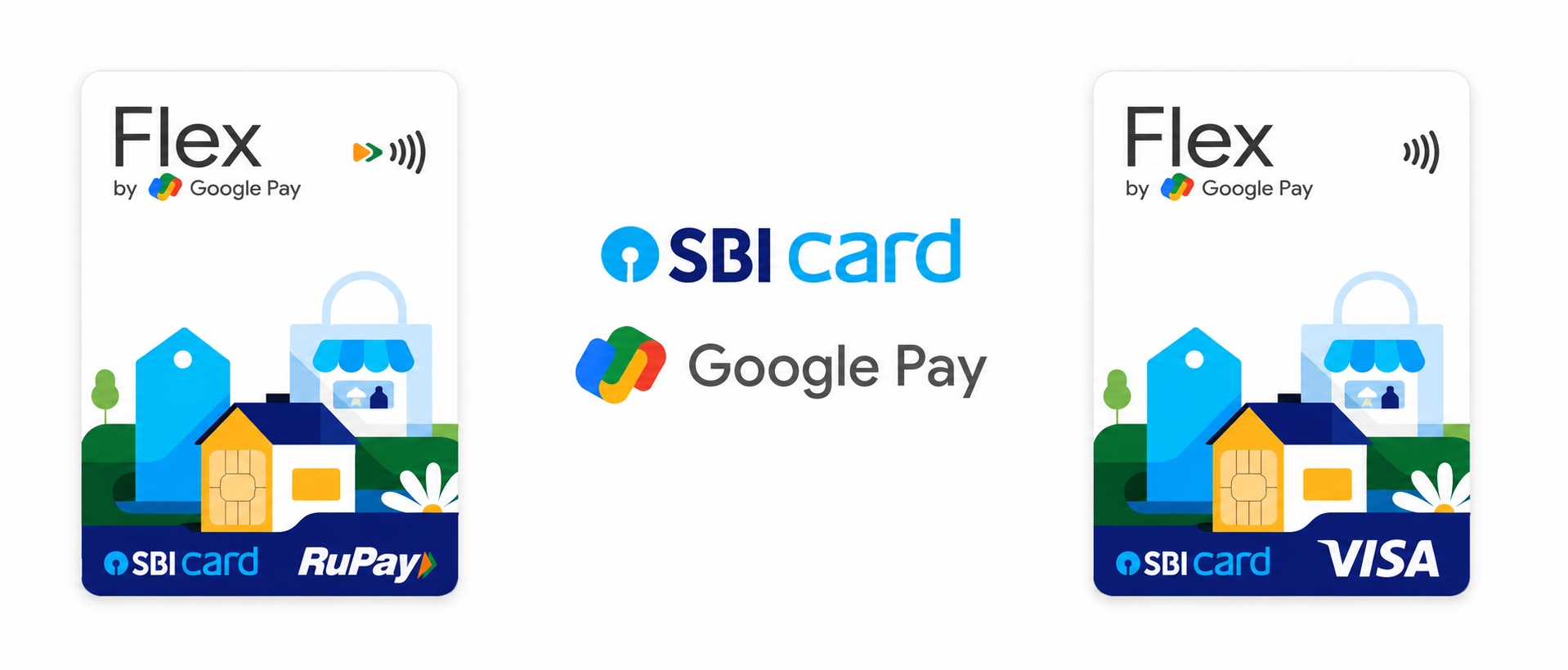
Google Pay and SBI Card have launched the Google Pay Flex SBI Card, a fully digital credit card built on the RuPay network, with Visa network access as well. This is Google Pay’s second cobranded credit card in India, after its December 2025 tie-up with Axis Bank.
The Google Pay Flex SBI Card is a paperless credit card you can apply for directly inside the Google Pay app. It runs on RuPay and Visa networks, lets you earn Stars instantly (1 Star = ₹1), and allows you to convert your outstanding bill into EMIs. It went live on July 28, 2026.
What Happened
SBI Card and Google jointly announced the launch of the Google Pay Flex SBI Card in Mumbai on July 28, 2026, as part of the existing ‘Flex by Google Pay’ credit experience. Alongside the card, Google also rolled out Ask Google Pay, a Gemini-powered chat assistant built into the Google Pay app.
The launch event was attended by Kunal Guha (Managing Director, Commerce Partnerships APAC, Google), Salila Pande (MD & CEO, SBI Card), Sohini Rajola (Executive Director Growth, NPCI), and Sharath Bulusu (Senior Director, Google Pay).
Key Features of the Card
- Apply directly from within Google Pay — no physical paperwork required.
- Works across both RuPay and Visa payment networks.
- Earn Stars on every Flex transaction, with instant redemption (1 Star = ₹1).
- Convert your latest outstanding credit card bill into flexible EMIs.
- Flex customers will soon get the Google AI Plus plan (400GB–2TB storage) at 50% off for one year, plus discounts across the Google Pixel range.
Ask Google Pay: The AI Layer Behind the Push
Ask Google Pay is an opt-in, Gemini-powered chat feature inside the app. It analyses a user’s spending patterns using their Google Pay transaction history and CIBIL report data, and answers questions on savings, SIPs, tax regimes, and credit scores.
Users can type or speak their queries, and the assistant responds in 10 Indian languages. Google has clarified that the tool gives financial information for educational purposes only, and is not a substitute for professional financial advice.
How This Compares to the Axis Bank Flex Card
The SBI tie-up is Google Pay’s second cobranded credit card after Axis Bank. Here’s how the two currently stack up on publicly available details:
| Feature | Google Pay Flex – Axis Bank | Google Pay Flex – SBI Card |
| Launched | December 2025 | July 28, 2026 |
| Network | RuPay | RuPay and Visa |
| Application process | Fully digital, in-app | Fully digital, in-app |
| Rewards | Stars (redeemable) | Stars, 1 Star = ₹1, instant redemption |
| Repayment flexibility | EMI conversion available | EMI conversion on outstanding bill |
| AI assistant support | Ask Google Pay (Gemini-powered) | Ask Google Pay (Gemini-powered) |
| Extra perks | Not specified | 50% off Google AI Plus for 1 year, Pixel discounts (rolling out soon) |
Fees, credit limits, and detailed eligibility criteria have not been disclosed publicly yet. Terms and conditions apply to the AI Plus and Pixel offers.
What This Means for India
The launch comes right after SBI Cards’ Q1 FY27 results, where standalone net profit rose 20% year-on-year to ₹664 crore, and total credit card spends grew 27% year-on-year to ₹1,18,475 crore. Routing card applications through Google Pay lowers SBI Cards’ cost of acquisition, since it taps directly into Google’s UPI user base of over 530 million.
For everyday users, the bigger shift is credit-on-UPI. RuPay credit cards linked to UPI already carry no interchange fee for small merchants on transactions up to ₹2,000, which is fuelling adoption in Tier-2 and Tier-3 cities. Expect more banks to follow this in-app, paperless issuance model over the next year.
What to Watch Next
- Official fee structure, credit limits, and eligibility criteria — not yet public.
- Rollout timeline for the Google AI Plus discount and Pixel offers tied to the card.
- Whether Google Pay adds a third bank partner, expanding the Flex lineup further.
MoneyHulk will update this article as SBI Card and Google Pay release more details on fees, credit limits, and eligibility.
Frequently Asked Questions
What are the joining and annual fees on this card?
The Google Pay Flex SBI Card carries a joining fee of ₹499 plus applicable taxes. The same amount, ₹499 plus taxes, applies as the annual renewal fee from the second year onward.
Can the annual fee be waived?
Yes. SBI Card offers a spend-based renewal fee reversal if you spend ₹1,00,000 or more on the card in the previous year.
Is there a welcome bonus?
Yes. New cardholders receive a welcome gift worth ₹1,000 on card issuance.
How do Stars work, and is there a cap?
You earn Stars on eligible spends — groceries, bill payments, travel bookings, utility payments, and shopping — with 1 Star equal to ₹1. The base rate accelerates with spending: cardholders can earn up to 4 Stars per ₹500 spent after crossing ₹15,000 in a billing cycle, and up to 8 Stars per ₹500 spent after crossing ₹30,000. Total Stars earned on everyday spends are capped at 18,000 per year.
Should I choose the RuPay or Visa variant?
Choose RuPay if you want to link the card to UPI and pay at any UPI-accepting merchant, including small shops that don’t take Visa. Choose Visa if you spend more at large retailers, online, or internationally, where RuPay acceptance is thinner. Both variants can be tokenised on Google Pay for tap-to-pay.
Can I convert my bill into EMIs?
Yes. You can convert your latest outstanding credit card bill into EMIs directly from the Google Pay app, instead of paying the full amount or carrying revolving interest.
Is Ask Google Pay safe to use with my financial data?
Ask Google Pay is opt-in and uses your Google Pay transaction history and CIBIL report data to personalise its answers. Google says this data stays under your control, and the assistant’s output is for educational purposes only, not financial advice — so treat it as a starting point, not a final answer, especially for tax or investment decisions.
How is this different from the Google Pay Flex Axis Bank card?
Both are fully digital, in-app cards with Stars-based rewards and EMI conversion. The Axis Bank Flex card runs on RuPay only and has no joining fee, while the SBI Flex Card adds a Visa option and carries a ₹499 joining and renewal fee (waivable on ₹1,00,000 annual spend). Compare both against your typical spend pattern before choosing.

Sethuram Kishore is the founder of MoneyHulk and Worthview, with over 18 years of experience in SEO, digital marketing, and online publishing. Since launching Worthview in 2008, he has published hundreds of articles across finance, business, technology, and consumer topics. Through MoneyHulk, he shares practical, research-backed guides on personal finance, investing, banking, entrepreneurship, and wealth building.


