


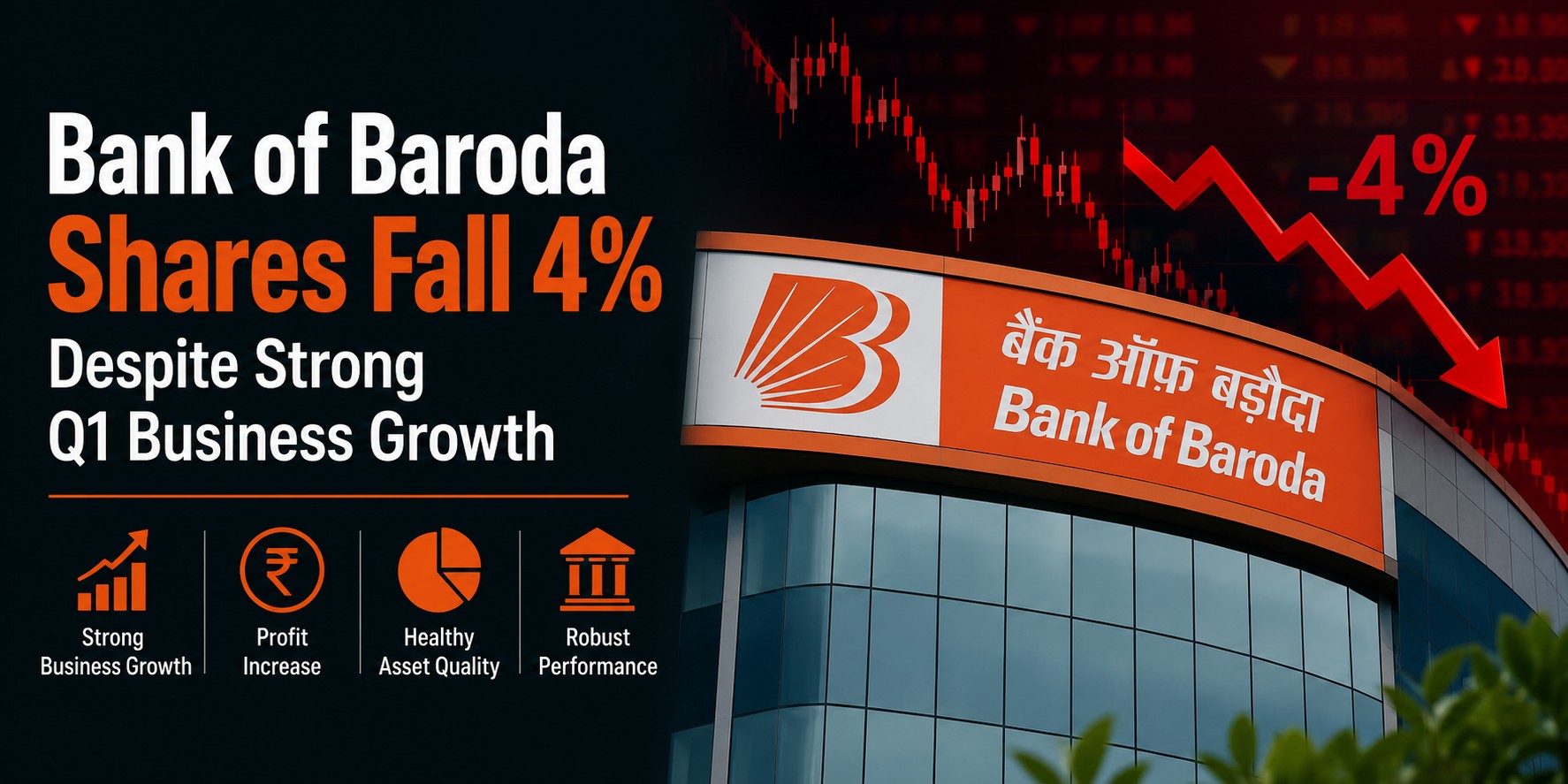
Bank of Baroda shares slipped 4.2% to close at ₹260.25 on July 2, 2026, even after the state-owned lender reported 15.46% year-on-year growth in global business for the quarter ended June 30. The drop follows a $600 million settlement with NMC Health that closes out years of litigation in Abu Dhabi and UK courts.
Q1 FY27 Business Update: The Numbers
Bank of Baroda’s provisional business update for the first quarter of FY27 shows strong, broad-based growth. The bank’s global business rose 15.46% YoY to ₹30.51 lakh crore, up from ₹26.43 lakh crore in the same period last year.
Loan growth continues to outpace deposit growth, a trend that’s been visible across Indian banks this year.
| Metric | Q1 FY27 | Q1 FY26 | YoY Growth |
| Global Business | ₹30.51 lakh crore | ₹26.43 lakh crore | 15.46% |
| Global Advances | ₹14.17 lakh crore | — | 17.42% |
| Global Deposits | ₹16.34 lakh crore | — | 13.81% |
| Domestic Advances | ₹11.51 lakh crore | ₹9.91 lakh crore | 16.14% |
| Domestic Retail Advances* | ₹3.09 lakh crore | ₹2.61 lakh crore | 18.45% |
*Excludes pool purchases.
On the profitability side, Bank of Baroda had earlier reported an 11.3% rise in standalone net profit for Q4 FY26, at ₹5,616 crore, up from ₹5,048 crore a year earlier. Net interest income rose 9% YoY to ₹12,494 crore, and gross NPAs improved to 1.89% from 2.04% in the previous quarter — a sign of steady asset quality.
The NMC Health Settlement, Explained
In a separate regulatory filing on the same day, Bank of Baroda announced an out-of-court settlement with NMC Health PLC, NMC Healthcare Ltd, and NMC Holding Ltd. The bank will pay $600 million (roughly ₹5,700 crore) to resolve all claims, without admitting any liability or wrongdoing.
NMC Health was a UAE-based hospital group that collapsed in 2020 after a debt scandal involving several Indian-linked promoters and lenders. Bank of Baroda, along with other banks, had been drawn into years of legal proceedings in Abu Dhabi Global Market (ADGM) courts and in the UK as administrators tried to recover dues on the group’s behalf.
This settlement ends that litigation entirely. The payment was reportedly made through the bank’s Abu Dhabi branch.
Why the Stock Fell Despite Good Numbers
This is the part that trips up a lot of retail investors: strong operating numbers, but the stock still fell. Here’s the simple explanation.
The market isn’t reacting to how well Bank of Baroda’s core lending business is doing right now — that part is genuinely healthy. It’s reacting to the fact that a $600 million settlement is a real cash outflow that will likely show up as a provision in the upcoming Q1 FY27 results, putting pressure on near-term profit.
| In simple words: A strong business update tells you the bank is growing well. A large one-time settlement tells you profit for this quarter will take a hit. Markets often price in the second thing faster than the first, which is why good operational news and a falling share price can happen on the same day. |
Brokerage Nomura has maintained a neutral rating on Bank of Baroda with a target price of ₹300, flagging that Q1 FY27 earnings are likely to be impacted by the settlement-related provisions.
What This Means for Investors
If you hold Bank of Baroda shares or a PSU banking fund, here’s how to read this development without overreacting.
- This is a one-time, non-recurring cost. It clears legal uncertainty that had been hanging over the bank for years, which is arguably a long-term positive even though it hurts one quarter’s profit.
- Core business fundamentals — advances, deposits, asset quality — remain strong. That’s the number to track over the next few quarters, not this one settlement.
- The stock is down 13.5% over the past six months but still up around 7% over one year. Short-term price moves like this are common around litigation news and shouldn’t be the sole basis for a buy or sell decision.
- If you’re a long-term investor via SIP in a banking or PSU-focused mutual fund, a single stock’s one-day move rarely changes the bigger picture.
As always at MoneyHulk, we don’t tell you whether to buy, hold, or sell. What matters is understanding why a stock moved, so your own decision is based on facts and not headlines.
What to Watch Next
- Bank of Baroda’s full Q1 FY27 results, expected in the coming weeks, will show the actual provisioning impact of the NMC settlement on net profit.
- Net interest margin (NIM) trends, since advances are growing faster than deposits — a pattern worth watching for margin pressure.
- Asset quality metrics (gross and net NPA) in the upcoming results, to confirm the improving trend continues.
- Any commentary from management on capital raising plans or dividend payout, discussed at the bank’s AGM held on June 23, 2026.

Sethuram Kishore is the founder of MoneyHulk and Worthview, with over 18 years of experience in SEO, digital marketing, and online publishing. Since launching Worthview in 2008, he has published hundreds of articles across finance, business, technology, and consumer topics. Through MoneyHulk, he shares practical, research-backed guides on personal finance, investing, banking, entrepreneurship, and wealth building.


