


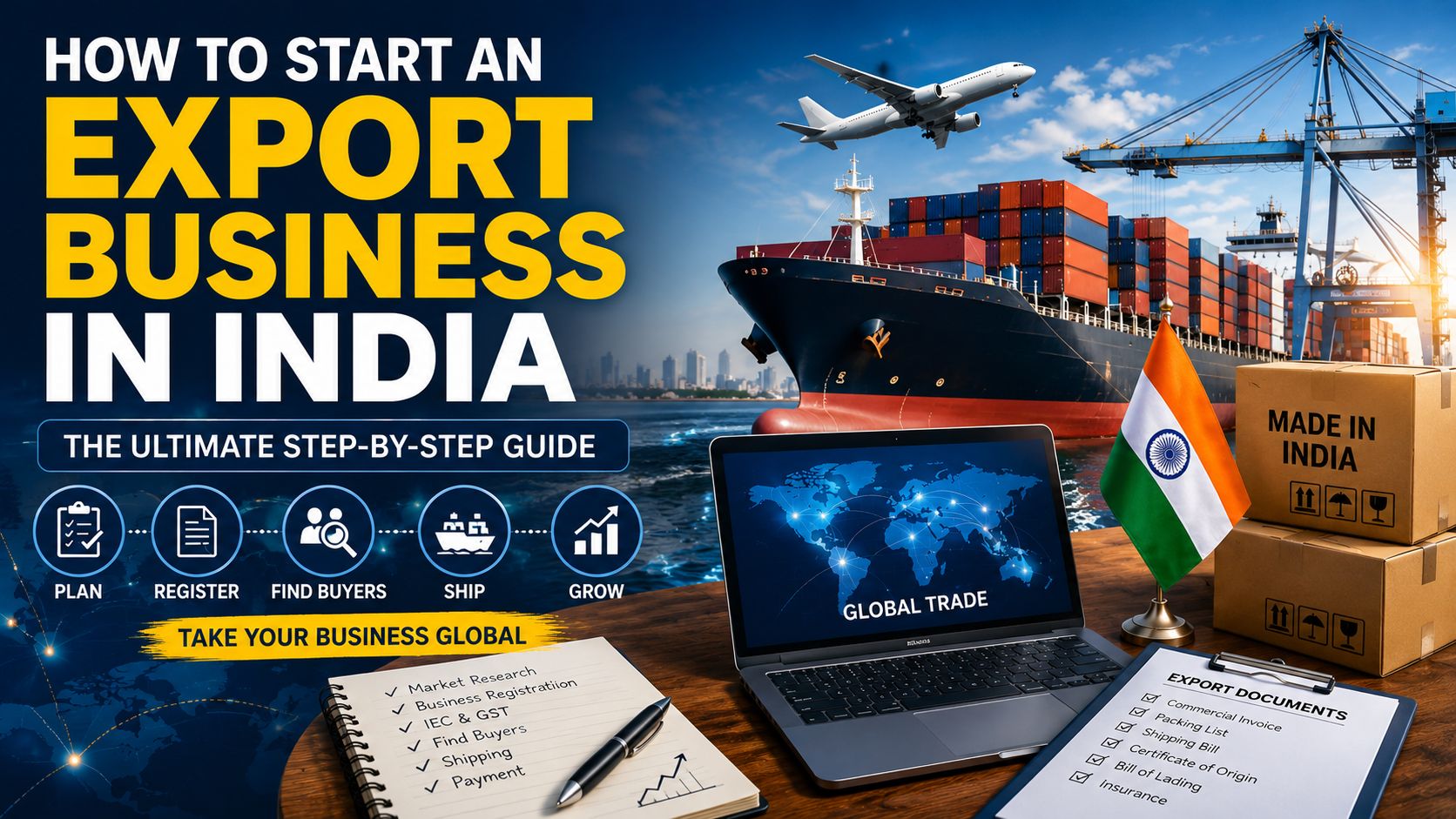
India has emerged as one of the world’s fastest-growing export economies, supplying everything from textiles and pharmaceuticals to engineering goods, agricultural products, spices, and software services to global markets. With increasing government support, digital trade platforms, and easier access to international buyers, starting an export business has become more accessible than ever before.
Whether you’re an entrepreneur looking to launch a new venture, a manufacturer seeking overseas customers, or a small business owner aiming to expand globally, exporting can open doors to significantly larger markets and higher profit margins.
India’s exports touched a record US$860 billion in FY 2025-26, and small manufacturers are a growing part of that number. Take Rahul, who runs a small cotton home-furnishing unit in Karur, Tamil Nadu. For five years he sold only to domestic wholesalers, until he decided to ship his first container to a buyer in Dubai. If you’re wondering how to start an export business in India, the short version is this: register your business, get an IEC code, pick the right product, complete a handful of compliance steps, and find your first overseas buyer. This guide walks through each step in the order Rahul actually followed them.
The best part? You don’t need a massive investment or a large company to get started. Many successful exporters begin with a small operation, focus on a niche product, and gradually scale their business as demand grows.
In short: To start an export business in India, register your business entity and GST, get an IEC (Import Export Code) from the DGFT, optionally register with an Export Promotion Council for an RCMC, get an AD Code from your bank, and file a GST LUT before your first invoice. Most exporters complete these registrations in 7 to 15 working days for under ₹20,000 in total fees, then spend a few more weeks or months finding their first buyer.
What Is an Export Business?
An export business involves selling goods or services produced in India to customers located in other countries. The exporter earns revenue in foreign currency while helping Indian products reach international markets.
For example:
- A spice manufacturer in Kerala exports cardamom to the UAE.
- A textile company in Surat ships garments to the United States.
- A handicraft seller in Jaipur supplies decorative products to European buyers.
In each case, the business generates income by supplying products to overseas customers.
How Does Exporting Work?
The export process generally follows these steps:
- Select a product with international demand.
- Identify target countries and potential buyers.
- Register your business and obtain an IEC.
- Negotiate pricing and order terms.
- Prepare export documentation.
- Arrange shipping and logistics.
- Deliver goods to the buyer.
- Receive payment in foreign currency.
Although the process may seem complex initially, modern digital tools, freight forwarders, and government initiatives have made exporting easier for first-time entrepreneurs.
Types of Export Businesses
1. Manufacturer Exporter
A manufacturer exporter produces goods and exports them directly to international buyers.
Examples:
- Textile manufacturers
- Food processing companies
- Furniture makers
- Engineering equipment manufacturers
2. Merchant Exporter
Merchant exporters purchase products from manufacturers and sell them overseas under their own brand or trading company.
This model is ideal for beginners because it requires lower investment and no manufacturing setup.
3. E-commerce Exporter
E-commerce exporters sell products directly to international consumers through platforms such as Amazon Global, Etsy, Shopify, and eBay.
Popular products include:
- Handmade products
- Jewelry
- Home décor
- Personalized gifts
4. Dropshipping Exporter
In this model, the exporter markets products internationally while suppliers handle inventory and shipping.
While easier to start, profit margins are often lower compared to traditional exporting.
Why Start an Export Business in India?
India is uniquely positioned to become a global export powerhouse due to its large manufacturing base, skilled workforce, competitive pricing, and favorable government policies.
Access to Global Markets
Instead of selling only within India, exporters can reach customers across the world. This dramatically increases market size and growth potential.
Higher Profit Margins
Many products command significantly higher prices in international markets compared to domestic markets.
Government Support
The Indian government actively promotes exports through various schemes, incentives, and trade agreements designed to help businesses compete globally.
Diversified Revenue Streams
Exporting reduces dependence on a single market and helps businesses remain resilient during local economic slowdowns.
Growing Global Demand for Indian Products
Several categories continue to experience strong international demand:
- Spices
- Rice
- Tea and coffee
- Organic foods
- Pharmaceuticals
- Textiles
- Handicrafts
- Engineering products
- Chemicals
- Leather goods
For entrepreneurs seeking a scalable business opportunity, exporting offers one of the most attractive paths to long-term growth.

Is an Export Business Right for You?
An export business is simply selling Indian goods or services to a buyer based outside India, and getting paid in foreign exchange. You don’t need a factory or a huge budget to start — many first-time exporters begin by exporting a product they already sell well in the domestic market.
- Capital: registrations cost under ₹20,000 in government fees; your real capital need is for inventory, packaging, and your first sample shipments.
- Skills: basic English for buyer communication, patience for paperwork, and consistency in product quality.
- Timeline: most first-timers take 2–4 months from decision to first shipment — 2–3 weeks on registrations, the rest finding a buyer.
Rahul already had a manufacturing line, so his real challenge wasn’t the product — it was the paperwork and finding his first overseas customer.
Step 1: Pick What You’ll Export
An export-ready product is one with steady overseas demand, consistent quality you can repeat at scale, and a price that still works after freight, duty, and your margin.
- Start with something you already manufacture or trade well domestically — don’t develop a new product just to export.
- Check demand signals on platforms like IndiaMART’s export section, Alibaba, or the government’s India Trade Portal.
- Confirm your ITC-HS code early — your duty rates, RoDTEP eligibility, and incentive amounts all depend on getting this classification right.
- Popular beginner categories: textiles & garments, handicrafts, processed foods & spices, leather goods, engineering components, and IT/software services.
In March 2026 alone, handicraft exports (excluding handmade carpets) grew over 8% year-on-year and engineering goods exports also grew — both common starting categories that show steady overseas demand.
Step 2: Register Your Business Entity and GST
Before DGFT or customs will recognise you as an exporter, you need a registered business entity and a GST number, because every export certificate is linked to your PAN and GSTIN.
A sole proprietorship is the simplest and most common starting point for first-time exporters — you can convert to an LLP or Private Limited company later if you bring in partners or raise funding. GST registration is mandatory once your turnover crosses the threshold (₹20 lakh for most states, ₹40 lakh for some categories), but most exporters register voluntarily even below that, since you need a GSTIN to file your LUT and claim export refunds.
Read – Sole Proprietorship vs OPC vs Private Limited: Which Is Right for Your First Business in India?
Step 3: Get Your IEC Code
The IEC (Import Export Code) is a 10-digit number from the Directorate General of Foreign Trade (DGFT) that works like your business’s passport for international trade — without it, customs won’t clear your shipment and your bank won’t process the foreign payment.
Apply online at dgft.gov.in. Your IEC number is the same as your business PAN, but you still need to formally apply for it. The process takes 1 to 3 working days and costs a flat ₹500 government fee. Your IEC has lifetime validity, but every holder must confirm their details on the DGFT portal each year between 1 April and 30 June — miss this window and your IEC gets deactivated, freezing customs clearance, bank payments, and incentive claims until you complete it.
Read our detailed guide on How to Get an IEC Code in India: Complete 2026 Guide
Step 4: Register for RCMC
RCMC (Registration-cum-Membership Certificate) is a certificate from an Export Promotion Council or commodity board confirming you’re registered for your product category — you need it mainly to access government export incentives, not simply to ship goods.
Apply through DGFT’s e-RCMC module using your active IEC. Pick the council that matches your main product — for example AEPC for garments, EEPC India for engineering goods, or FIEO if your products don’t fit a specific council. An RCMC is valid for 5 financial years from 1 April of issue, and the fee varies by council, typically a few thousand rupees. Rahul registered with his textile export council after his first shipment, so he could start claiming incentives on future orders. If you’re only shipping once or twice, you can skip this; if you’re building a serious export business, get it early.
Step 5: Get an AD Code From Your Bank
An AD (Authorised Dealer) Code is a code your bank issues that links your current account to customs, so you can receive foreign payments and generate a shipping bill. Unlike the IEC, which is one central registration, the AD Code must be registered separately at every port or airport you plan to ship from.
Visit your bank with your IEC and GST certificate, request the AD Code letter, and register it on ICEGATE for each port you’ll use. This usually takes 2 to 5 working days and is free at most banks.
Step 6: Find International Buyers
Finding your first overseas buyer is usually the hardest, slowest part of starting an export business — far harder than any single registration.
- B2B marketplaces: IndiaMART’s export section, Alibaba, TradeIndia.
- Export Promotion Council buyer-seller meets and international trade fairs.
- Government resources: the India Trade Portal and Indian embassy commercial wings abroad.
- Direct outreach to overseas distributors and retailers on LinkedIn.
- Working with an established merchant exporter first, to learn buyer expectations before going solo.
Rahul found his first UAE buyer at a textile trade fair organised through his Export Promotion Council — a common path for first-timers in garments and handicrafts.
Step 7: Get Your Pricing, Documentation and Payment Terms Right
Every export shipment needs a specific set of documents and a payment term that protects your cash flow — especially with a buyer you haven’t worked with before.
Core export documents:
- Proforma invoice — a quote you send before the order is confirmed.
- Commercial invoice — the final bill stating value and terms, used by customs on both ends.
- Packing list — what’s actually inside each box or container.
- Bill of Lading (sea) / Airway Bill (air) — the transport document proving the goods were shipped.
- Certificate of Origin — proves the goods were made in India, often needed for the buyer’s duty benefits.
A GST LUT (Letter of Undertaking) is a declaration filed on the GST portal that lets you export without paying IGST upfront, since exports are treated as zero-rated supplies under GST law. File Form GST RFD-11 online — it’s free, takes about 10–15 minutes, and is valid for one financial year (1 April to 31 March). File it before your first export invoice of the year, since it can’t be applied retroactively to earlier invoices.
Choosing payment terms:
- Advance payment — buyer pays before you ship; safest for a first-time exporter with a new buyer.
- Letter of Credit (LC) — your bank receives a payment guarantee from the buyer’s bank; safer for larger orders.
- Open Account (OA) — you ship first and the buyer pays later, usually in 30–90 days; convenient for buyers but riskiest for you, generally reserved for buyers you’ve worked with repeatedly.
Step 8: Handle Shipping and Customs Clearance
A Customs House Agent (CHA) files your customs paperwork at the port, while a freight forwarder arranges the actual sea or air transport — many small firms offer both services together.
- Book shipping space through your forwarder.
- File the shipping bill on ICEGATE, declaring your RoDTEP claim at this stage — it cannot be added retroactively.
- Customs may examine the cargo if your shipment is selected for inspection.
- A “Let Export Order” (LEO) is issued and the goods are loaded.
For a first shipment, hiring a CHA / freight forwarder combination is far more practical than trying to self-file.
Step 9: Claim Export Incentives and Get Paid
Once your goods are shipped, India’s main export support comes through a handful of DGFT schemes — the biggest being RoDTEP — plus your bank’s job of getting your foreign payment into your account.
RoDTEP (Remission of Duties and Taxes on Exported Products)
RoDTEP refunds embedded taxes and duties — things like fuel tax or mandi tax — that get built into your cost but aren’t refunded anywhere else. Rates currently run roughly 0.3% to 4.3% of your shipment’s FOB value depending on your product’s HS code, paid as a transferable electronic scrip via ICEGATE. The scheme has been extended at existing rates until 30 September 2026, though the FY 2026-27 budget allocation was cut to ₹10,000 crore from ₹18,233 crore the year before — a reminder that rates and outlay can change with little notice, so always check your live HS code rate on the DGFT site rather than assuming last year’s number.
EPCG (Export Promotion Capital Goods Scheme)
If you plan to import machinery to manufacture your export goods, EPCG lets you bring it in at zero customs duty. In exchange, you commit to exporting goods worth six times the duty you saved, within six years. This is more useful once you’re scaling production than for your very first shipment.
Advance Authorisation
Advance Authorisation works the same way for raw materials instead of machinery — it lets you import inputs duty-free, provided you add at least 15% value and export the finished goods within 18 months.
Interest Equalisation Scheme
There’s also an Interest Equalisation Scheme that has historically given exporters — especially MSMEs — cheaper pre- and post-shipment rupee credit from banks. This scheme is reviewed and renewed periodically, so check with your bank or a trade consultant for its current status before counting on it in your costing.
Getting paid
When your buyer pays, your bank issues an e-FIRA or FIRC (foreign inward remittance certificate) as proof of payment — keep this safely, since it’s needed for GST refunds, RCMC renewal, and EPCG / Advance Authorisation closure. RBI rules generally require export proceeds to be realised within nine months of the shipment date.
Costs and Timeline at a Glance
| Step | Typical Cost | Typical Time |
| Business registration + GST | ₹0 – ₹5,000 | 3 – 7 days |
| IEC Code | ₹500 (govt fee) | 1 – 3 working days |
| RCMC (optional) | ₹2,000 – ₹10,000, varies by council | 7 – 15 working days |
| AD Code | Usually free from your bank | 2 – 5 working days |
| GST LUT | Free | Same day (10–15 minutes online) |
| CHA / Freight Forwarder | Per-shipment service fee, no fixed govt cost | Ongoing, per shipment |
Most first-time exporters spend roughly ₹3,000 to ₹20,000 on registration and government fees before their first shipment — the bigger cost is usually freight and packaging, not compliance.
Common Mistakes First-Time Exporters Make
- Skipping RCMC and missing out on incentive schemes later.
- Forgetting the April–June IEC annual update and getting deactivated mid-order.
- Filing GST LUT after the first invoice of the financial year, which blocks it from applying and locks up working capital in IGST.
- Accepting Open Account terms with a brand-new, unverified buyer.
- Misclassifying the HS code, which throws off duty and RoDTEP calculations.
- Quoting a price without checking current freight rates, which can erase a thin margin.
Conclusion
Starting an export business in India isn’t one big leap — it’s a series of small, well-defined steps: registering your business, getting your IEC, picking the right product, and steadily building buyer relationships. A good first step is getting your IEC code sorted this week — everything else in this guide builds on that one registration.
Frequently Asked Questions
Q: Is IEC mandatory to start an export business in India?
A: Yes, for almost every exporter of physical goods. Without an IEC, customs will not clear your shipment and your bank cannot process the foreign payment. The only exceptions are specific government bodies and small-value personal shipments to neighbouring countries.
Q: How much does it cost to start an export business in India?
A: Government fees alone typically add up to ₹3,000–₹20,000, covering GST registration, the ₹500 IEC fee, and an optional RCMC. Your bigger costs will usually be packaging, freight, and sample shipments rather than compliance.
Q: Do I need RCMC to export from India?
A: No, RCMC isn’t mandatory simply to ship goods, but you do need it to claim most government export incentives tied to your Export Promotion Council. Most exporters who plan to export regularly get one within their first few shipments.
Q: Can I export from India without registering a company?
A: Yes, a sole proprietorship is enough to get an IEC and start exporting, which is how most first-time Indian exporters begin. You can always convert to an LLP or Private Limited company later as your export volumes grow.
Q: How long does it take to start exporting after getting an IEC?
A: The IEC itself takes 1–3 working days, but RCMC, AD Code, and GST LUT can add another one to two weeks. Most first-timers spend 2–4 months in total before their first shipment, mostly finding and finalising a buyer.
Q: What is the easiest product to export from India as a beginner?
A: Categories you already manufacture or trade in domestically are usually easiest, since you skip the product-development stage entirely. Textiles, handicrafts, spices, and processed foods are common starting points because they have steady overseas demand and relatively simple documentation.
Q: Do exporters need to pay GST on exports from India?
A: No, exports are treated as zero-rated supplies under GST law, meaning you don’t pay IGST if you’ve filed a valid LUT before your first export invoice of the financial year. Without an LUT, you’d need to pay IGST upfront and later claim a refund, which ties up working capital for weeks or months.

Sethuram Kishore is the founder of MoneyHulk and Worthview, with over 18 years of experience in SEO, digital marketing, and online publishing. Since launching Worthview in 2008, he has published hundreds of articles across finance, business, technology, and consumer topics. Through MoneyHulk, he shares practical, research-backed guides on personal finance, investing, banking, entrepreneurship, and wealth building.


